Showing posts with label Suncheon. Show all posts

Friday, January 11, 2008

Japanese homes in Maegok-dong.

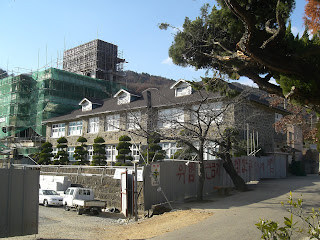
For those into this kind of thing, here's a picture of one of the few Japanese-style buildings in Maegok-dong I mentioned in my second-to-last post. This one is located just up the alley (south of) Maesan High School (매산고), and has seen better days.


Here's another old house in the area that may or may not be in the Japanese-style, I can't really tell. It's a block or two south of Suncheon Hyanggyo (순천향교, one of the Confucian academies), so not actually in Maegok-dong, but I thought it looked neat, regardless.

Tuesday, January 8, 2008

Missionaries in Suncheon


An earlier incarnation of Jungang Church, est. 1907, in Maegok-dong. The photo was stolen from here.


I've rushed this entry a bit, and wasn't as thorough as possible in a few spots, because I wanted to get something out before I go out of town for most of the rest of January. I've been sitting on this post for over a month, and I'll have to do a little more digging later. This also isn't meant to be exhaustive or authoritative . . . I was just curious about some stuff around town, that's all.

I first wandered through Maegok-dong in late-November, when I was looking for some information about a monument to the Yosu-Sunchon Incident that was supposed to be there. Maegok-dong is just west of Suncheon's Old Downtown, just across the Medical Rotary (의료원 R) from McDonald's and Bukbu Market. I don't know the exact boundaries of Maegok-dong, but it occupies 1.42 square kilometers and includes the medical rotary in the south, the university in the north, and in between reaches a few blocks west of Jungang-ro (중앙로). According to Naver it had a population of 10,309 in 2001, but according to the Maegok-dong website, that number decreased to 7,421 four years later. In 1931, Maegok-ri was incorporated in Suncheon-eup (eup/읍 means town), and when Suncheon-eup became Suncheon county in 1949, Maegok-ri was elevated to a dong/동, a larger administrative division.It's an interesting little neighborhood, with lots of little alleys, homes seemingly piled on top of one another, a couple of Confucian academies, a few crumbling Japanese-style homes, and several big schools. (Okay, so it's probably like a lot of other Korean neighborhoods, but I'm easily amused.) Anyway, turns out it was also one of the first places in the region to host American missionaries.


(Top) A picture of a village in Maegok-dong, circa 1913. Really remarkable. I stole it from this Naver blog, but I wanted to upload it myself in case the other blog went down. (Bottom) Old picture of Western-style buildings in Maegok-dong. The one on the left was a hospital that is no longer there. This photo, along with about a dozen others, are on dislpay in an alley across the street from Suncheon National University.

A timeline* at the Historical Museum of Korean Christian Mission (sic) (한국 기독교 선교 역사 박물관) in Suncheon says that missionaries were first dispatched to the southern region---the two Jeollas and Chungcheongnam-do---in 1893. In February, 1893---according to the timeline, anyway---Reverend William Davis Reynolds and Reverend Lewis Boyd Tate arrived in Jeonju and stayed for two weeks. Dr. Alexander D. Drew, M.D., arrived the following year and was the first medical missionary to the country. The timeline continues to mention that Reverend Reynolds and Tate toured the Jeollas in March, 1894, making trips to Gunsan, Yeosu, Suncheon, Mokpo, and other lesser-known towns and counties. In March, 1897, Reverend Eugene Bell established Yangdong Church (양동교회) in Mokpo, apparently the first church in the Honam region. In 1901 Fredrica Straeffer started teaching girls in Mokpo at what would become Jeongmyeong Girl's High School two years later. Incidentally, that school's website has a small gallery of pictures from the early 20th century here. Also in 1903 in Mokpo, the Youngheung School, known today as Yeongheung High School (영흥고등학교), was established. In commermoration of the 100th anniversary a few years back, the school put together a newsletter with a bunch of articles (in Korean) and some pictures of campus buildings through the years. It is available as a .pdf file here. There is also a gallery with 81 pages of photos of people, events, and buildings through the years, available here.

Getting back to Suncheon, the timeline is actually a little vague about initial efforts in the city. As mentioned the two early missionaries made a tour of the Jeollas and stopped in Suncheon in 1894. The next mention is in 1909, when "John F. Preston and Rev. William D. Reynolds suggested a station in Soonchun." The following year, Deacon Yoon Soo Kim (김윤수) bought ten acres of land "which was named Mai-san-deung"---매산 등, currently occupied by the three Maesan schools and the old seminary---"with the help of Mr. Eok-pyung Kim of Soonchun-Eub Church (now Soonchun Central Church)." If you happened across Suncheon Central Church (순천중앙교회) in December, you'd know that it's celebrating its "101th Christmas" (sic), and the church website confirms that the church was founded in 1907 by John F. Preston. The building that stands now was finished in 1983, but in front of the main entrance is a small statue with a plaque of J. F. Preston.


Another old picture of Central Church, the second incarnation, I believe. I don't remember where I stole this.

Reverend Preston would have a hand in founding three other local points of interest: Maesan Middle School (매산중), Maesan High School (매산고), and Maesan Girls High School (매산여고). All three are private Presbyterian schools founded in 1910 by Preston and Robert Thornwell Coit. Maesan Middle School made the news last year when a bus crash claimed the lives of 5 students on Jirisan. There are a few older Western-style buildings on the campus, although I don't know exactly when they were built, and quick searches for cornerstones turned up nothing. If you start from Jungang Church and walk past the clinic and up the hill, you will first pass the middle school, then the girls' high school, then the high school. In between the girls' high school and middle school is the site of the old seminary. On the campus of the middle school, bordered on two sides by a construction zone, is a large Western-style building presently used as the library and probably for other things, too. The girls' high school has two Western homes, one on each end of the playground. The most dominant feature on the high school campus is a large, brand new gymnasium that you can see from a few blocks away.


(Top) Large building on the campus of Maesan Middle School. (Middle) Old, one-time house at the entrance of Maesan Girls' High School. Currently the "교목실." (Bottom) Old building at the opposite end of Maesan Girls' High School.

I mentioned the clinic and museum, located right behind Central Church. The clinic (순천기독진료소) was established in 1960 by Lois F. Linton and is located on the first floor of a Western-style brick home. On the second floor is a small museum with a collection of photographs, letters, and other artificats of and from early missionaries not only to Suncheon but to other cities like Gwangju, Yeosu, Mokpo, and Jeonju. On the third floor is a cozy little apartment with furniture dating to the mid-20th century. I was pleasantly surprised by the museum, and its worth a visit if you're in the area. There isn't much English, though, and I'm sure the trip would have been much more useful could I understand more of the displays. Anyway, when you get there you'll have to first stop into the clinic and ask them to unlock the door.


The clinic and museum, behind Central Church (중앙교회).

The clinic there is one of three related tuberculosis (결핵) care facilities set up in Suncheon by American missionaries. There is also a "rest village" (요양원) a bit east, and the "Lois Village" (보양원) in Haeryong-myeon. You may be able to glean a little more information from the official site, stoptbkorea.com. A couple blocks west of the schools is a care facility called 애양재활원. I haven't been able to find any information online about this at all, and I don't know what it does or what, if any, relation it has to the other care centers in the area. There are a few Western-style buildings on the site, though, although I don't know how old or authentic they are.


A building at a care center (애양재활원) a few blocks west of the three Maesan schools.

While doing a little write-up on Missionary Wilson's House in Gwangju I came across some familiar names. For example, the Reverend Thomas Dwight Linton served as principal of the Honam Theological Seminary from 1973 to 1978. That seminary was formed when the Honam Bible School, the Suncheon Maesan Seminary, and Gwangju Night School merged in 1961, and is known today as Honam Theological University and Seminary. The HTUS campus includes a small hill, on top of which is a cemetary where many early missionaries and their family members are interred. Among those at that cemetary is Eugene Bell, who first arrived in Korea in 1895 and who established the aforementioned Yangdong Church in Mokpo in 1897. His wife died in 1901 and is buried at the Foreigner's Cemetary in Seoul. One hundred years after his arrival in Korea, the EugeneBell Foundation was established to provide medical and developmental assistance to North Korea.

It was founded by Dr. Stephen Linton, great-grandson of Eugene Bell. He has a very sloppy wikipedia page here. His brother, Dr. John Linton, is director of Severance Hospital International Health Care Center at Yonsei University, and is one of the most notable foreigners in the country, if you could even call him a foreigner at this point. There is a little interview with Dr. Linton here, from the Tour2Korea website. [Update, March 11: Thanks to The Marmot's Hole for the tip about an article in the Washington Post on Dr. Linton and his work in North Korea.]

Another group with familial ties to the original settlers that provides assistance to North Korea is Wellspring, a project out of the Western Carolina Presbytery in North Carolina. The "Ruling Elder" is James Linton, another great-grandson of Eugene Bell. The Wellspring homepage says that Mr. Linton's father founded some 165 churches in Korea.

The relative youth of these "old" buildings in Maegok-dong is something that struck me when I first learned about all those buildings on campus, and even back when I visited the Wilson House in Gwangju. These structures date to the early-20th century---the Wilson House to 1920---and are some of the oldest buildings in the region. But all the houses in my grandparents' neighborhood in Pittsburgh are older than these buildings, and I chuckled a little when I realized I was taking pictures of buildings that wouldn't attract the slightest bit of attention back home. That's the way Korea is, and because of wars, invasions, natural disasters, and neglect, it's not uncommon to have family members older than historical sites here. In fact, I'm older than the present-day Nagan-eupseong Folk Village, although there have been different versions of it for 1300 years.

* A lot of the names and dates in this post are based on the timeline. When possible I've tried to check against other online sources. I'm inclined to trust the timeline, although because the romanization and the Western names are a little inconsistent, and some known facts aren't included, we can't be sure that other information is completely accurate.

Friday, January 4, 2008

Sunday, December 30, 2007

첫눈 First Snow

We had our first snow of the year in Suncheon on Sunday, and there's about a quarter-inch on the ground right now. The Korea Times tells us:
The weather agency forecast up to 30 centimeters of additional snow in the region by Monday.

The article, "Heavy Snow Hits Southwest," also tells us:
A heavy snow alert was issued for about 20 cities and counties in the North and South Jeolla provinces. Jeongeup had 22.5 centimeters of snow, with Gochang having 19 centimeters, Gwangju 18 centimeters, Imsil 12.5 centimeters and Gunsan 10 centimeters.

and:
Some 70 ferries remained anchored in port, and dozens of flights were grounded at airports in Gwangju, Muan and Yeosu.

and is accompanied by this picture:


From what I hear it's customary here to send a text message to your boyfriend or girlfriend when the 첫눈 arrives. Having neither, I didn't notice until I ventured out this evening. As I hate cold weather it's a shame, because it was in the 50s for Christmas.

Also from the Korea Times, Korea and China are fighting about Taekwondo (grow up you two), and an actress's suicide is the most shocking news item of the year.

Thursday, December 27, 2007

Saturday, December 15, 2007

Searching for famous graduates.

For some reason I landed on the Hampyeong county Wikipedia page the other day, and saw that somebody added a line about Hakdari High School and its famous graduates. While trying to learn more about this I found an interesting feature on Naver: the ability to search notable people by the schools they attended. The search turns up 5 for Hakdari HS, and I don’t really recognize any of them. I was kinda hoping for a pop star or two. The most notable person is Lee Yong-sup, Minister of Construction and Transportation since December, 2006.

To find out how prestigious your school’s graduates are, do a people search on Naver and select 출신학교 from the drop-down menu. The search will also turn up public servants, doctors, and the like.

Gangjin High School (강진고등학교) produced one notable person, the actor 박노식, who was in movies like The Host and 200 Pound Beauty. Maesan High School (매산고등학교), a private Presbyterian school in Suncheon, turns up 58 names (a lot of public servants, lawyers, and businessmen). Daewon Foreign Language High School (대원외국어고등학교), one of the most prestigious high schools in the country, turns up 14 names, including actors and singers, and Gwangju's International High School (국제고등학교) turns up three, including the insufferable Mun Geun-yeong and the model 조희.


Mun Geun-yeong, the "nation's little sister" and spawn of Gwangju's Kukje H.S. Her most notable film role is 어린신부, in which she plays a high school student betrothed to her cousin.

Sunday, December 9, 2007

TIME magazine on the 1948 Yosu-Sunchon Incident.

The TIME magazine website has two little articles about the Yosu-Sunchon Incident, both from November, 1948.

First is an article from November 1, 1948, titled "From One Source."
One day last week, Radio Moscow announced that Russian troops had begun to pull out of North Korea. On the same day, a Communist-inspired revolt broke out in Korea's southern tip.

The Russian withdrawal in the north worried South Koreans more than did the vest-pocket southern uprising. The Russians were leaving behind them a firmly installed Communist regime with a well-trained army of 150,000. The departure of the Red army was intended to bring pressure on the U.S. to withdraw its troops, leaving a South Korean constabulary and militia totaling about 60,000 to face the far stronger northern force.

Dr. Syngman Rhee, President of the two-month-old South Korean Republic, was in Tokyo visiting Douglas MacArthur at the time. Said MacArthur: "I will defend Korea as I would my own country—just as I would California."

With MacArthur's words to encourage them, the South Korean army energetically set about crushing the revolt. It had begun one morning before dawn, when 40 Communist members of a brigade stationed in the far southern port of Yosu shot their officers and bullied their sleepy comrades into attacking the city police station. They took over all of Yosu, then headed north, picking up confused recruits along the way. By the time they reached Sunchon, a city of 75,000, their force had grown to
around 2,000.

Brigadier General Song Ho's loyal troops quickly drove the rebels out of Sunchon, and chased them back into the rough, hilly country to the south. It was hard to tell friend from foe. Both loyal and rebel troops wore U.S. uniforms and carried U.S. weapons. Loyal troops finally put on white armbands. Said young Lieut. Colonel Kang Yung Noon: "What sadness that we had to fire our first bullets against our own brothers."

At week's end government forces had retaken most of the territory won by the rebels; they expected to recover Yosu soon. Asked who was responsible for the revolt, President Rhee said: "We really do not know." Then he pointed a finger to the north and added: "But all of our troubles come from one source."
Next is a report from November 8, 1948, filed by Carl Mydans, who was accompanying the government troops.

The pretty little valley of Sunchon ("Peaceful Heaven") rests neatly at the bottom of the rugged Chiri Mountains, twelve miles north of the port of Yosu. On the morning of Oct. 20, Sunchon's farmers were harvesting their rice, when they heard a siren and the rattle of small arms from the railroad station. They looked up to see 2,000 rebel soldiers and 400 civilians swarming off a train from Yosu.

The rebels approached Sunchon city peacefully; but as soon as they entered the city, police opened fire. Joined by a company of soldiers guarding the city bridge, the rebels fired back. After a short, sharp battle they were in full control. The hundred or so cops who surrendered were lined up against the wall of the police compound and riddled. Then the rebels, joined by part of the citizenry, paraded through the city under North Korea's Communist banner, singing "Ten thousand years to the North Korean People's Republic!"

Star-Spangled Shirt. When darkness came, Communist execution squads went from house to house, shooting "rightists" in their beds or marching them to collection points where they were mowed down. In 2-3-days, 500 civilians were slaughtered. U.S. Lieuts. Stewart M. Greenbaum and Gordon Mohr, Army observers in Sunchon, narrowly escaped death. The rebel sergeant assigned to kill them was an old friend, who had drunk beer with them in their billet many times. He took the two officers into a field, fired into the ground and then led them to the Presbyterian Mission of Dr. John Curtis Crane, who was barricaded in with his wife and four other missionaries.

From one of the doctor's shirts and a few colored rags the ladies made a 16-star, eleven-stripe U.S. flag and put it up. The rebels began pounding at the compound gate, yelling: "Let's kill the Americans!" Suddenly one shouted: "No, no, not them; they are my friends." It was the lieutenants' friend, the sergeant. The rebels went away.

For the first few hours the loyal troops who retook Sunchon were as savage as the Communists had been. On the big compound of the Sunchon Agricultural and Forestry School we found what was left of the entire population of Sunchon. Women with babies on their backs watched without expression as their husbands and sons were beaten with clubs, rifle butts and steel helmets. They saw 22 of them marched away to the primary school nearby, and heard the volley of rifles which killed them.

"Get the Americans Out." Two days later, entering Yosu, the town where the revolt began, the government troops were much better behaved. The Communists' occupation of Yosu revealed the pattern they would like to impose on all South Korea. After arrest and murder of police and loyal leaders, the rebels took over all communications, banks, schools and food distribution. They established a "People's Committee" as the new government. The "People's Committee" announced: "Our two-point program: 1) to oppose, to the death the killing of our brothers, and 2) to get the Americans out of here."

Though the recapture of Yosu has temporarily stalled the revolt, most of the rebel troops have, melted off into the countryside and mountains with their weapons. Yosu's fall was not the end of a war; it was only the beginning. The general civilian point of view was expressed by one woman we found squatting in a shack on the outskirts of Yosu just after the fight had gone by her door. When we asked her whom she was for she replied: "I'm for you. You are the strongest."


The Suncheon Agricultural and Forestry School is present-day Suncheon National University. A few days ago I posted about the placards around Suncheon that mark notable sites during the rebellion. The one on the campus reads:
At the time of the Yosun Incident, the quell force, made up of police and defense guard troops, used the Suncheon Middle School of Farming and Forestry (the predecessor of the present Sunchon National University) as their camp and headquarter when they attacked the insurgent forces in downtown Suncheon on Oct. 22th. The nearby Suncheon Northern Elementary School was the site of questioning and executing of civilians who were suspected of taking sides with the insurgents. The victims were executed without trial on the levee of a rice paddy behind the school's auditorium.

There are a few articles on the rebellion from the New York Times. I thought their archives were free, but since they're not, I can't get to them. Anyone interested can comb through these search results.

Thursday, December 6, 2007

Placards about the Yosu-Sunchon Incident around Suncheon (여순사건관련지)


I've come across a few placards around Suncheon marking notable places during the Yosu-Sunchon Incident of 1948 (which also known as the Yosu Rebellion, the Yosu-Sunchon Rebellion, and other variations). I haven't found many internet sources in English on the internet, so I find these placards kind of useful. I'd also be interested to know what happened during this time---between World War II and the Korean War---in other areas of Jeollanam-do (specifically Gangjin). Anyway, for a little background on the incident, there are two articles here and here.

I've come across three placards so far: at Suncheon Station, at Dongcheon River, and at Suncheon National University. I originally assumed 관련지 meant "placard," but looking in the dictionary I see "관련" means "relation, connection, association." All three of the placards marking sites associated with the incident are two-sided, and all three contain the following text on one side:
The Yosun Incident broke out on Oct. 19, 1948, when the 14th Regiment of the National Defense Guard of South Korea refused to move to Jeju Island on a mission to put down an armed uprising protesting against the estasblishment of the government by South Korea alone. When about 2,000 soldiers marched into downtown Yeosu, the civilians,students and local leftists, who were suffering from economic distress after the establishment of the new government, joined the soldiers. The insurgent forces instantly occupied eastern areas of Jeonnam Province, i.e., Suncheon, Gwangyang, Gurye, Boseong, Goheung, and Gokseong. The government established the quell force headquarter in Gwangju and defeated the insurgent forces in Suncheon on Oct. 23 and in Yeosu on Oct. 27. During the search operation against the civilian collaborators, many innocent civilians were executed without trial. The number of victims of the Yosun Incident is estimated to be about 10,000 including policement, soldiers, and civilians, though the exact number is not known.
The Yosun Incident served as a momentum for establishing 'anti-communism' as the national idiology for South Korea and fixation of the partition of the Korean peninsula.
I didn't change any errors in spelling, punctuation, grammar, or spacing, and I didn't alter any of the romanization.

On the flip side of the placard in front of Suncheon Station is the following:
Suncheon Station bore witness to the early stages of the Yosun Incident. The insurgent forces used Suncheon Station as a base to attack downtown Suncheon while they were extending their influence outside Yeosu. At 8:39 Oct. 20, 1948, abotu two thousands of the insurgent forces left Yosu by train and other vehicles, and arrived at Suncheon Station at around 09:30 without facing any resistance. Two companies of the 14th Regiment, which had been dispatched to Suncheon, joined the insurgent forces under the command of 1st Lt. Hong Soonsuk. The joint forces were able to easily break through the resistance of the police troops who were defending Gwangyang Saguri (a three forked road) and the bank of Dongchun Stream, and advanced toward downtown Suncheon. The current building of the Suncheon Station was rebuilt in October, 1960.
The placard on the banks of Dongchun/Dongcheon is about 15 minutes away. From Suncheon Station, walk west toward the river. Follow the pedestrian on-ramp to your right and start walking north along the river. It is on the east side of the stream, along the walking path, tucked under Suncheon Bridge (순천교).


The placard reads:
The Suncheon Bridge (Jangdaedari) and the bank of Dongchun Stream witnessed the first fierce combat between the police and the insurgent forces at the time of the Yosun Incident. On October 20th, the Suncheon police and right-wing youths from adjacent regions established a defensive line at Gwangyang Samguri, but failed to keep the insurgent forces from advancing to downtown Suncheon because the 4th Regiment, a support troop from Gwangju, joined the insurgents. During the combat, most of the policement escaped from the spot, some were killed, and only about 50 retreated to the Suncheon Police Station.

The third placard I found is located on Suncheon National University, behind the graduate school / language center (대학원 / 어학원), number 2 on this map. If exiting the building, turn left and at the street turn left, and the placard will be visible a few meters on your left.

The placard says "여순사건관련지 - 순천농림중학교 (현 순천대학교), or Suncheon Middle School of Farming and Forestry (presently Suncheon National University). According to the Suncheon University site, the Farming and Forestry middle school was established in 1946, became a high school in 1951, a vocational high school in 1965, a technical college in 1973, a college in 1979, a four-year college in 1982, and finally Suncheon National University in 1991.

The placard reads:

At the time of the Yosun Incident, the quell force, made up of police and defense guard troops, used the Suncheon Middle School of Farming and Forestry (the predecessor of the present Sunchon National University) as their camp and
headquarter when they attacked the insurgent forces in downtown Suncheon on Oct. 22th. The nearby Suncheon Northern Elementary School was the site of questioning and executing of civilians who were suspected of taking sides with the insurgents. The victims were executed without trial on the levee of a rice paddy behind the school's auditorium.
Suncheon Northern Elementary School (presently 전남순천북초등학교) is located about a half-kilometer south of Suncheon University.

Tuesday, December 4, 2007

Suncheon's 국도극장

A little while ago I posted an entry about Suncheon's movie theaters, mostly to make it easier for me to find show times. I mentioned a few theaters that don't exist anymore, one of them being 국도극장, in Suncheon's "Old Downtown."


It's located next to the Lotteria, although if you look at this map from Naver, you'll see that the Lotteria is in the wrong place. The Lotteria, and the theater, are next to the 의료원, about 240 meters north, which is why I'm convinced the theater is actually one of the two dark masses you'll see appearing just east of "서인과" up there. Anyway, the one-screen theater is pretty small, and if you trust the crude measuring stick on Naver maps it's around 30 meters long. The theater and Lotteria are a few spots south of McDonald's, which you can see on the map here.

In front of the theater today is an empty, glass-fronted room that used to hold a "Crocodile" clothing store. There's an old-timey poster for the movie "만죽거리잔혹사," a poster that was not there when I first noticed the theater a few months ago.


You'll also see that general admission tickets at the time of the theater's closing cost 5,500 won. One of the few websites I found mentioning the theater was a Naver 지식 answer from January, 2004, so the was either still open or still thought to be open at that time. Running a very rudimentary search with my dumb-ass Korean ability, I see that 5,500 was the going rate in 2003 and 2004, so I guess the theater first closed around that time. The blog entry I just linked is from February, 2004, and it talks about seeing the movie "Ing," which came out in November, 2003, so I wonder if these smaller theaters showed movies that had past their first run. But, to piss on that theory, the movie in the poster, "만죽거리잔" came out in January, 2004.


Anyway, I'd been meaning to post a picture in the old entry I made, but the reason I bring it up today is because, as I had suspected, the theater will reopen. Well, if you trust my judgment and the authority of the lady working at the "로즈버드" across the street.

Tuesday, November 20, 2007

Train Stations in Suncheon


There are many things I have not yet done in Korea during my sheltered existence. I have not been to Jeju or Mokpo. I have not been to a 찜질방. And I have never taken a train. I'm sure it's easy enough, and I guess plenty of foreigners do it, but I've just always found taking a bus pretty convenient. The English-language Korail site is a joke, with an incomplete and outdated map and no timetables. The Korean-language site isn't much better, although at least there's an improved way of searching through schedules. Not that it matters much, as foreigners aren't able to buy tickets online, thus defeating the purpose of using an online booking system. Since I would have to physically go to the station to get the tickets, there's no reason for me not to just take a bus.

Anyway, in a small attempt at reducing the disinformation out there about trains and train stations, earlier this fall I edited the "Jeolla Rail" template on Galbijim, and took out nearly twenty stations that are no longer in operation. The template has since been reverted to its unabridged form. Eight of these defunct stations are within the Suncheon city limits. From north to south (between Guryegu Station and Suncheon Station) are:

* Bongdeok Station (봉덕역), in Hwajeong-myeon.
* Goemok Station (괴목역), in Hwajeong-myeon, 1936-1999
* Gaeun Station (개운역), in Seo-myeon
* Dongeun Station (동운역), in Seo-myeon, ?? - 2005
* Seongsan Station (성산역), in Haeryong-myeon, 1952-2005
* Pyeonghwa Station (평화역), 1968-2004
* Dong Suncheon Station (동순천역), 1936-2004

And from the southwest from Beolgyo to Suncheon Station is:

* Guryong Station (구룡역), in Byeolryang-myeon
* Wonchang Station (원창역), in Byeolryang-myeon

The only operational station in town is Suncheon Station, a few blocks from the Intercity Bus Terminal. The station was rebuilt in 1960, and is accessible by just about every local bus in town. According to an artist's rendering inside, it looks like they're building a new one. (There's some construction going on next door, I wonder if that's it). You can see the picture here, if you scroll down. Suncheon Station is, incidentally, a good place to go if you've decided to visit Suncheon without doing your homework. Outside of the station to the left is a Tourist Information Center (관광안내소), where you can get all kinds of maps, brochures, and bus schedules.

Guryegu Station is also in Suncheon, but I don't really consider it "in town" because it's . . . not really in town. It's on the outskirts, across the river from Gurye-eup, Gurye county, north of the old Bongdeok Station.

According to an article from the 경상신문, 15 stations in Jeollanam-do closed in 2005, although I have to doubt the veracity of stuff in the article, as some of the locations are wrong (Yulchon Station, for example, is in Yeosu, not Suncheon, and Yangbo Station isn't in Suncheon, either).

Anyway, there are quite a few websites about train stations, and it's easy to find photos with a Naver search. Kicha.org (기차 as in train) is a good one, and it has a mirror Naver cafe, from whence I stole a bunch of photos for this post. I Love Train is another one. When I do Naver searches for these defunct railway stations, most of the results are from these two sites, or from blogs that borrow the information. Here are a few photos that I turned up, and *goddamnit* since I can't do captions without screwing up the layout of the entire page, I'll tell you now that, from top to bottom, is Seongsan Station, Pyeonghwa Station, Guryong Station, and Gaeun Station.


Visiting and photographing these old stations must be a popular pastime here. I tried to participate, and on the first day of the Chuseok break I visited Yulchon Station in Yeosu. It's old and tiny, and although there were two people working in the office, I don't think passengers use it any longer. Around that time I decided to visit Seongsan Station, as I thought it was within walking distance of my school. If you check the Naver map here, you'll see that it's in the middle of an apartment complex, which is entirely possible if the area was built up after the photo galleries were taken. Only after wandering around for an hour and returning home did my dumb ass follow the railroad tracks on the Naver map and find that Seongsan is further east, in the middle of nowhere.

There are photo galleries available for most of the stations in Suncheon. You can see more pictures of Seongsan Station here and here. One for Dongun Station is here and one for Gaeun Station is here. Two for Bongdeok Station are here and here, and there are two for Pyeonghwa Station, here and here.

Monday, November 19, 2007

Movie theaters in Suncheon.

* 7/16/09 Update: I updated the two movie theater links. Please leave a comment or email me if you find other broken links; otherwise, I'll have a hard time keeping track.

There are two movie theaters in Suncheon: Primus and Lotte. Primus Cinema (프리머스시네마) is next door to Suncheon City Hall in Jakcheon-dong, and is attached to the area known as "Old Downtown" by a fancy, newly-constructed pedestrian street. Apparently it was the former location of 맘모스극장. Anyway, this Primus Cinema opened on December 18, 2003, has 8 screens, and has a Lotteria on the ground floor. You can see what's playing now on their website. It is accessible via a ton of buses---1.21.22.23.24.25.53.60.61.62.63.88---and it's roughly 10 minutes behind the Intercity Bus Terminal on foot, and about five minutes from the bright, crowded Old Downtown shopping area. It's the tallest building in the area, and is easy to find after dark because there are multi-colored lights ringing the top.
Lotte Cinema (롯데시네마) is basically across the street from the Homever latest Home Plus. You can find out what's playing and get showtimes for Suncheon by clicking on 전라/광주 on the map on the homepage and then selecting Suncheon. Buses 64, 71, and 777 pass by the theater and stop near Homever, but weather permitting you could make the 10-minute walk from E-Mart or the 15-minute walk from Suncheon Station.

There are a few other theaters in Suncheon that aren't operational any longer. I've tried to get information on them, to the best of my ability, but haven't been able to find much. One is the old 국도극장, in Old Downtown. The building itself is still there, and is next to the Lotteria, partially obscured by an abandoned clothing store. The ticket window is still there, and at the time of the theater's closing, general admission prices were 5,500 won. Another is 황금극장, also in Old Downtown, in a presently vacant building. According to the guy on Naver, there were two screens there. I've found references to a few others---순천시네마극장, K2 시네마, and 코리아극장---but my Korean isn't good enough to figure out where they are/were.

[Edit (12/04/07): I just put up a little post about 국도극장, in "Old Downtown."]

Wednesday, October 17, 2007

Photo galleries on Korean blogs.

Koreans like to travel and take pictures. That's nice, because it means that a Naver search on just about any location, large or small, will point to at least a few blogs and cafes about the place. There are photos and often profiles about tons of different villages, temples, abandoned train stations, mountains, harbors, you name it. Another nice thing is that a lot of people post their day's photos in sequence, meaning its easy to retrace their footsteps and estimate driving directions, hiking trails, or itineraries. People looking to visit or live in a particular area of Korea should poke around Naver or another portal site, as you can probably find pictures and information on just about anything. Anyway, I've linked to a few below. I was going to post more, as I've seen tons of great photo galleries, but just like when you can easily find PC방 or convenience stores, except when you really need one, I had trouble finding the links I'd collected earlier.

*Here's a group of women who walked from Suncheon Station to Guryegu Station, some 30.32 kilometers away. Looks like they went along Dongcheon for a while, and it looked like something I'd like to try . . . but after seeing that they walked through the tunnel and along the highway, I dropped the idea.


*This guy as three quality posts on Gageo-do (가거도), an island in Shinan county that looks to be among the furthest removed from peninsular South Korea. It's roughly 136 kilometers from Mokpo. His entries are here, here, and here.

Friday, October 12, 2007

Yeosu, Suncheon, and Gwangyang to merge by 2010.

This is pretty big news for me, and I just found out about it while doing a google adventure. I guess news of the agreement broke in early September. In an effort to bolster Yeosu's chances of hosting the 2012 World Expo, these 3 neighboring cities plan to merge, creating a metropolitan area of 700,000 + in three districts. Basically, what that means for me is there will be a lot more work to do on the Galbijim Wiki, haha.

From the Chosun Ilbo:

The cities of Yeosu, Suncheon and Gwangyang in South Jeolla Province are to be merged into a new metropolis-level city. The new city will have an area of 1,856 sq.km, a little larger than Busan and Ulsan combined (1,820 sq.km), and a population of more than 720,000. At a debate hosted by Yeosu MBC on Wednesday, Yeosu Mayor Oh Hyun-sup, Suncheon Mayor Roh Kwan-kyu and Gwangyang Mayor Lee Sung-woong agreed to merge the three cities by 2010 to maximize the effect of investments in the region around Gwangyang Bay and create a new, more competitive city.


From the Dong-A Ilbo:

The city is reportedly planning to further integrate with Hadong and Namhae in the Gyeongnam region. That is an ambitious scheme to remove the distinction between the Yeongnam and Honam regions. The immediate objective for the integration of Yeosu, Suncheon, and Gwangyang is to be selected as the host of the World Expo. Currently, Yeosu is far smaller than its competitor cities overseas in terms of population size. The three cities intend to sign an MOU for integration before November 27 when the host will be selected. As the World Expo’s effects will equate to 10 trillion won of output growth and the employment of 80,000 people, it is an opportunity that cannot be missed. Gwangyang has POSCO’s steel mill, which is the largest in the world, while Suncheon has long been a famous education city. Therefore, once integrated, they could be an invincible team. There have been 40 cases of integration of local administrative districts. The Yeosu of today was born by merging Yeosu City, Yeocheon City and Yeocheon County in 1998. Suncheon is the combination of Suncheon City and Seungju County in 1995. Likewise, Gwangyang is the combination of Dong Gwangyang City and Gwangyang County in 1995.


From the Korea Times:

According to Yeosu Community Research Institute, 62.6 percent of Yeosu residents, 65.1 percent of Suncheon residents and 60.9 percent of Gwangyang residents were in favor of the merger.

Again, this is pretty surprising, and will create a very bizarre metropolis. As the Dong-A Ilbo article says, all three cities were assembled countless times by absorbing, realigning, and renaming different towns, villages, and fields. In fact, much of Jeollanam-do is this way, which is why, when you see the banner in your school describing your town's history, there are so many name changes throughout the centuries, as suchandsuch-ri was elevated to suchandsuch-myeon, which was absorbed into someother-myeon, which was divided . . . and so on, until the Japanese came and undid all that.

Anyway, when you drive through Suncheon or Yeosu (can't speak for Gwangyang), you find a lot of sprawl, and a few minute outside of either city you'll find factories, mountains, rice fields, or water. Suncheon, as we know it today, is a product of Seungju and Suncheon towns; Yeosu has three city halls from prior mergers; Gwangyang . . . is boring. So this will be messy.

Tuesday, September 18, 2007

Suncheon Drama Set

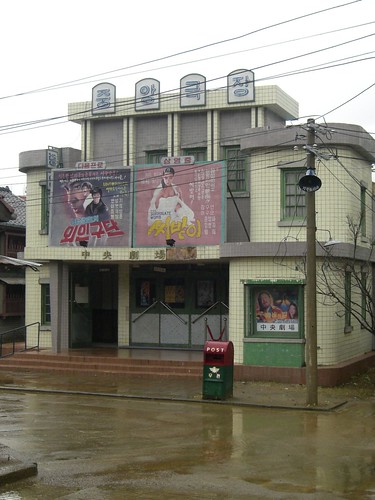
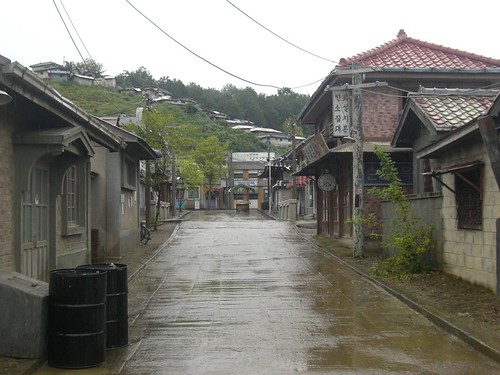
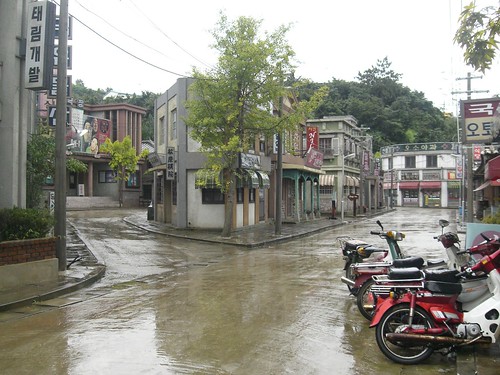
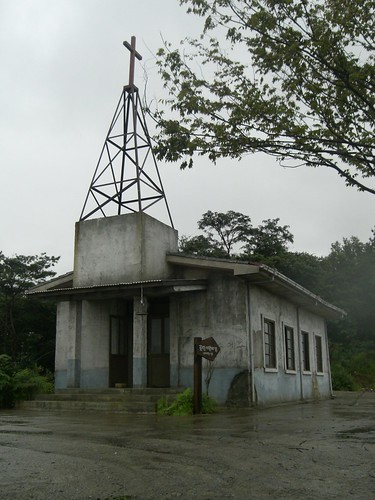
The day before Nari came I visited the Suncheon Drama Set, which, it turns out, is only a few blocks from my schools. It was used as a shooting location for some scenes of the SBS drama "Love and Ambition" (사랑과 야망). Despite the rain it was a pleasant trip, and I enjoyed walking through the park for an hour basically alone, as the weather kept folks away. Those interested in visiting should read the write-up on Galbijim and take a look at the SBS site (in Korean). There are a number of clips available on Youtube as well.

It's part of the Suncheon City Tour, but it seems a little off the beaten path. I hadn't heard of it until a week or so ago, when I saw a poster. Anyone interested in going can either do the city tour, or get on city bus 777, which will drop you off near the entrance. Anyway, the set is divided into 3 parts: 1960s Suncheon-eup, 1980s Seoul, and a generic 1970s slum, set on a hill in the back of the facility. One of the biggest differences between the Suncheon-eup set and the Seoul set was the amount of not only English, but English loan words written in Hangeul (Korean script). In Suncheon-eup, all of the signs were either written in Hanja (Chinese characters), or were Sino-Korean or Korean words.

I also want to add, before I post a few pictures, that "eup" translates to town, though in some cases it might be easier to think of it as "county seat." Suncheon eventually became an independent city, and grew in size when other towns were added to it. Before it became Suncheon-si (city), it was Suncheon-eup. Last year I lived in Gangjin-gun (county), Gangjin-eup, the largest town in the county and the county seat. On more than a few occassions, 1960s Suncheon-eup reminded me of 2007 Gangjin-eup.

"Central Theater" in Suncheon-eup.


A street in Suncheon-eup.


An intersection in Seoul.


A view of the "slum" (달동네).


A picture of a poster showing people on set in 1980s Seoul.


A church on top of the 달동네 hill. Fairly typical design of small country chapels.


I have 49 photos of the Drama Set on my flickr page, and the quality is a lot better.

Monday, September 17, 2007

Typhoon Nari in Suncheon

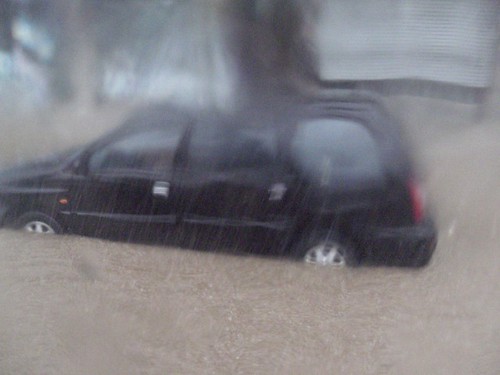
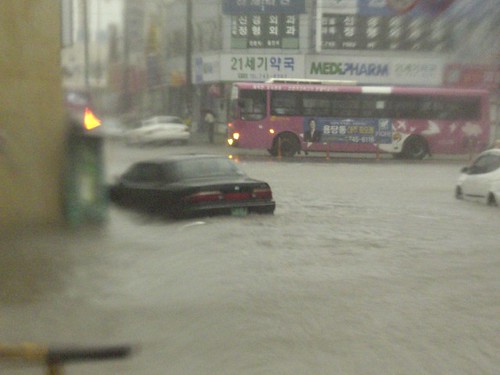
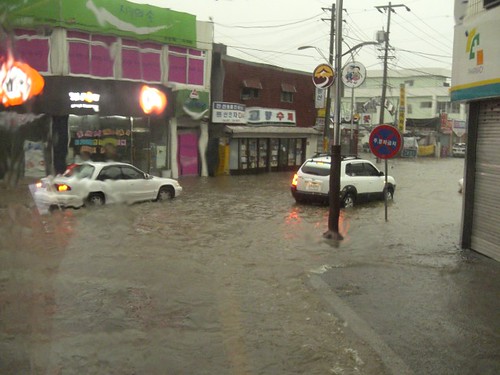
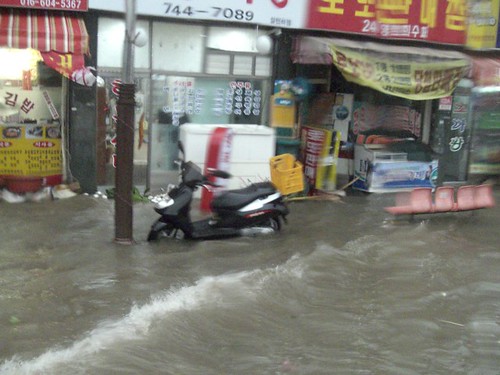
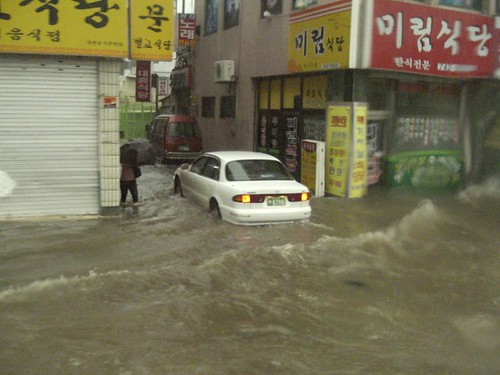
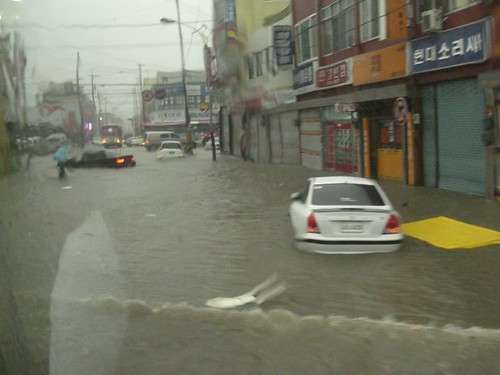
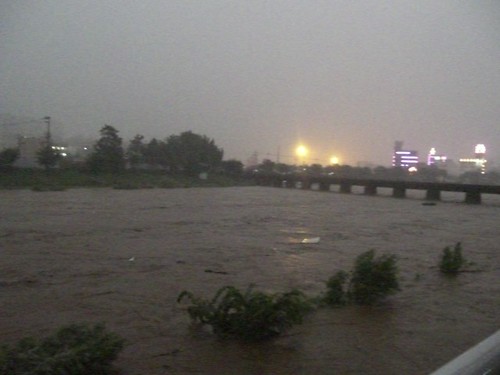
I've posted these pictures elsewhere, but they're worth showing again. They're of Typhoon Nari (태풍나리) as it hit Suncheon, Jeollanam-do between 6 and 7 pm on Sunday, September 18. I was in Gwangju for the afternoon, and as the bus hit the outskirts---around Seo-myeon, north of downtown---the road had about a foot of water mixed with a lot of run-off from hills and fields. The more we got into town the deeper the water, and the blocks around the Intercity Bus Terminal had as much as a meter of water. I had to wade through the muck to get out of the terminal---no buses or taxis were going in or out, and the terminal was basically an island---and ended up walking some 6 kilometers back to my place. I was not happy.


This last photo is of Dongcheon, the river that runs through Suncheon. Normally there are walkingtrails along the river, but in this picture only the tops of the trees are visible, suggesting the water has risen at least 3 or 4 meters.


For comparison purposes, here's a photo taken in calmer weather from nearly the same spot. The walkers on the path add a bit of perspective:


There are another 20 or so visible on my flickr page.