Showing posts with label 1948 Yosu-Sunchon Incident. Show all posts

Sunday, December 9, 2007

TIME magazine on the 1948 Yosu-Sunchon Incident.

The TIME magazine website has two little articles about the Yosu-Sunchon Incident, both from November, 1948.

First is an article from November 1, 1948, titled "From One Source."
One day last week, Radio Moscow announced that Russian troops had begun to pull out of North Korea. On the same day, a Communist-inspired revolt broke out in Korea's southern tip.

The Russian withdrawal in the north worried South Koreans more than did the vest-pocket southern uprising. The Russians were leaving behind them a firmly installed Communist regime with a well-trained army of 150,000. The departure of the Red army was intended to bring pressure on the U.S. to withdraw its troops, leaving a South Korean constabulary and militia totaling about 60,000 to face the far stronger northern force.

Dr. Syngman Rhee, President of the two-month-old South Korean Republic, was in Tokyo visiting Douglas MacArthur at the time. Said MacArthur: "I will defend Korea as I would my own country—just as I would California."

With MacArthur's words to encourage them, the South Korean army energetically set about crushing the revolt. It had begun one morning before dawn, when 40 Communist members of a brigade stationed in the far southern port of Yosu shot their officers and bullied their sleepy comrades into attacking the city police station. They took over all of Yosu, then headed north, picking up confused recruits along the way. By the time they reached Sunchon, a city of 75,000, their force had grown to
around 2,000.

Brigadier General Song Ho's loyal troops quickly drove the rebels out of Sunchon, and chased them back into the rough, hilly country to the south. It was hard to tell friend from foe. Both loyal and rebel troops wore U.S. uniforms and carried U.S. weapons. Loyal troops finally put on white armbands. Said young Lieut. Colonel Kang Yung Noon: "What sadness that we had to fire our first bullets against our own brothers."

At week's end government forces had retaken most of the territory won by the rebels; they expected to recover Yosu soon. Asked who was responsible for the revolt, President Rhee said: "We really do not know." Then he pointed a finger to the north and added: "But all of our troubles come from one source."
Next is a report from November 8, 1948, filed by Carl Mydans, who was accompanying the government troops.

The pretty little valley of Sunchon ("Peaceful Heaven") rests neatly at the bottom of the rugged Chiri Mountains, twelve miles north of the port of Yosu. On the morning of Oct. 20, Sunchon's farmers were harvesting their rice, when they heard a siren and the rattle of small arms from the railroad station. They looked up to see 2,000 rebel soldiers and 400 civilians swarming off a train from Yosu.

The rebels approached Sunchon city peacefully; but as soon as they entered the city, police opened fire. Joined by a company of soldiers guarding the city bridge, the rebels fired back. After a short, sharp battle they were in full control. The hundred or so cops who surrendered were lined up against the wall of the police compound and riddled. Then the rebels, joined by part of the citizenry, paraded through the city under North Korea's Communist banner, singing "Ten thousand years to the North Korean People's Republic!"

Star-Spangled Shirt. When darkness came, Communist execution squads went from house to house, shooting "rightists" in their beds or marching them to collection points where they were mowed down. In 2-3-days, 500 civilians were slaughtered. U.S. Lieuts. Stewart M. Greenbaum and Gordon Mohr, Army observers in Sunchon, narrowly escaped death. The rebel sergeant assigned to kill them was an old friend, who had drunk beer with them in their billet many times. He took the two officers into a field, fired into the ground and then led them to the Presbyterian Mission of Dr. John Curtis Crane, who was barricaded in with his wife and four other missionaries.

From one of the doctor's shirts and a few colored rags the ladies made a 16-star, eleven-stripe U.S. flag and put it up. The rebels began pounding at the compound gate, yelling: "Let's kill the Americans!" Suddenly one shouted: "No, no, not them; they are my friends." It was the lieutenants' friend, the sergeant. The rebels went away.

For the first few hours the loyal troops who retook Sunchon were as savage as the Communists had been. On the big compound of the Sunchon Agricultural and Forestry School we found what was left of the entire population of Sunchon. Women with babies on their backs watched without expression as their husbands and sons were beaten with clubs, rifle butts and steel helmets. They saw 22 of them marched away to the primary school nearby, and heard the volley of rifles which killed them.

"Get the Americans Out." Two days later, entering Yosu, the town where the revolt began, the government troops were much better behaved. The Communists' occupation of Yosu revealed the pattern they would like to impose on all South Korea. After arrest and murder of police and loyal leaders, the rebels took over all communications, banks, schools and food distribution. They established a "People's Committee" as the new government. The "People's Committee" announced: "Our two-point program: 1) to oppose, to the death the killing of our brothers, and 2) to get the Americans out of here."

Though the recapture of Yosu has temporarily stalled the revolt, most of the rebel troops have, melted off into the countryside and mountains with their weapons. Yosu's fall was not the end of a war; it was only the beginning. The general civilian point of view was expressed by one woman we found squatting in a shack on the outskirts of Yosu just after the fight had gone by her door. When we asked her whom she was for she replied: "I'm for you. You are the strongest."


The Suncheon Agricultural and Forestry School is present-day Suncheon National University. A few days ago I posted about the placards around Suncheon that mark notable sites during the rebellion. The one on the campus reads:
At the time of the Yosun Incident, the quell force, made up of police and defense guard troops, used the Suncheon Middle School of Farming and Forestry (the predecessor of the present Sunchon National University) as their camp and headquarter when they attacked the insurgent forces in downtown Suncheon on Oct. 22th. The nearby Suncheon Northern Elementary School was the site of questioning and executing of civilians who were suspected of taking sides with the insurgents. The victims were executed without trial on the levee of a rice paddy behind the school's auditorium.

There are a few articles on the rebellion from the New York Times. I thought their archives were free, but since they're not, I can't get to them. Anyone interested can comb through these search results.

Thursday, December 6, 2007

Placards about the Yosu-Sunchon Incident around Suncheon (여순사건관련지)


I've come across a few placards around Suncheon marking notable places during the Yosu-Sunchon Incident of 1948 (which also known as the Yosu Rebellion, the Yosu-Sunchon Rebellion, and other variations). I haven't found many internet sources in English on the internet, so I find these placards kind of useful. I'd also be interested to know what happened during this time---between World War II and the Korean War---in other areas of Jeollanam-do (specifically Gangjin). Anyway, for a little background on the incident, there are two articles here and here.

I've come across three placards so far: at Suncheon Station, at Dongcheon River, and at Suncheon National University. I originally assumed 관련지 meant "placard," but looking in the dictionary I see "관련" means "relation, connection, association." All three of the placards marking sites associated with the incident are two-sided, and all three contain the following text on one side:
The Yosun Incident broke out on Oct. 19, 1948, when the 14th Regiment of the National Defense Guard of South Korea refused to move to Jeju Island on a mission to put down an armed uprising protesting against the estasblishment of the government by South Korea alone. When about 2,000 soldiers marched into downtown Yeosu, the civilians,students and local leftists, who were suffering from economic distress after the establishment of the new government, joined the soldiers. The insurgent forces instantly occupied eastern areas of Jeonnam Province, i.e., Suncheon, Gwangyang, Gurye, Boseong, Goheung, and Gokseong. The government established the quell force headquarter in Gwangju and defeated the insurgent forces in Suncheon on Oct. 23 and in Yeosu on Oct. 27. During the search operation against the civilian collaborators, many innocent civilians were executed without trial. The number of victims of the Yosun Incident is estimated to be about 10,000 including policement, soldiers, and civilians, though the exact number is not known.
The Yosun Incident served as a momentum for establishing 'anti-communism' as the national idiology for South Korea and fixation of the partition of the Korean peninsula.
I didn't change any errors in spelling, punctuation, grammar, or spacing, and I didn't alter any of the romanization.

On the flip side of the placard in front of Suncheon Station is the following:
Suncheon Station bore witness to the early stages of the Yosun Incident. The insurgent forces used Suncheon Station as a base to attack downtown Suncheon while they were extending their influence outside Yeosu. At 8:39 Oct. 20, 1948, abotu two thousands of the insurgent forces left Yosu by train and other vehicles, and arrived at Suncheon Station at around 09:30 without facing any resistance. Two companies of the 14th Regiment, which had been dispatched to Suncheon, joined the insurgent forces under the command of 1st Lt. Hong Soonsuk. The joint forces were able to easily break through the resistance of the police troops who were defending Gwangyang Saguri (a three forked road) and the bank of Dongchun Stream, and advanced toward downtown Suncheon. The current building of the Suncheon Station was rebuilt in October, 1960.
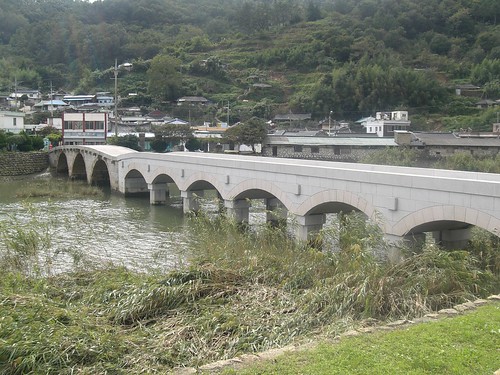
The placard on the banks of Dongchun/Dongcheon is about 15 minutes away. From Suncheon Station, walk west toward the river. Follow the pedestrian on-ramp to your right and start walking north along the river. It is on the east side of the stream, along the walking path, tucked under Suncheon Bridge (순천교).


The placard reads:
The Suncheon Bridge (Jangdaedari) and the bank of Dongchun Stream witnessed the first fierce combat between the police and the insurgent forces at the time of the Yosun Incident. On October 20th, the Suncheon police and right-wing youths from adjacent regions established a defensive line at Gwangyang Samguri, but failed to keep the insurgent forces from advancing to downtown Suncheon because the 4th Regiment, a support troop from Gwangju, joined the insurgents. During the combat, most of the policement escaped from the spot, some were killed, and only about 50 retreated to the Suncheon Police Station.

The third placard I found is located on Suncheon National University, behind the graduate school / language center (대학원 / 어학원), number 2 on this map. If exiting the building, turn left and at the street turn left, and the placard will be visible a few meters on your left.

The placard says "여순사건관련지 - 순천농림중학교 (현 순천대학교), or Suncheon Middle School of Farming and Forestry (presently Suncheon National University). According to the Suncheon University site, the Farming and Forestry middle school was established in 1946, became a high school in 1951, a vocational high school in 1965, a technical college in 1973, a college in 1979, a four-year college in 1982, and finally Suncheon National University in 1991.

The placard reads:

At the time of the Yosun Incident, the quell force, made up of police and defense guard troops, used the Suncheon Middle School of Farming and Forestry (the predecessor of the present Sunchon National University) as their camp and
headquarter when they attacked the insurgent forces in downtown Suncheon on Oct. 22th. The nearby Suncheon Northern Elementary School was the site of questioning and executing of civilians who were suspected of taking sides with the insurgents. The victims were executed without trial on the levee of a rice paddy behind the school's auditorium.
Suncheon Northern Elementary School (presently 전남순천북초등학교) is located about a half-kilometer south of Suncheon University.

Monday, October 1, 2007

Beolgyo (벌교)

A few days ago I visited the town of Beolgyo, in Boseong county. It's thirty minutes away by bus, has 19,000 people, and is known for its Japanese colonial architecture, for its violent 1940s, and for being the setting of the novel Taebaek Sanmaek. Before I get into the post, I'll link to two great posts from two great bloggers: (1) this one, from The Marmot's Hole, has good pictures and talks about Beolgyo's history, and (2) this one, from Antti Leppanen, talks a little about the sites mentioned in the novel.

Here's a little background from The Marmot's Hole:

If you’ve got an interest in contemporary Korean history, there’s plenty to see and feel in Beolgyo, a town that is, for all intents and purposes, a product of Japanese colonial policy. The town was developed as a transportation center to ship agricultural goods from the Jeolla provinces to ports like Yeosu. The Japanese also engaged in a number of ambitious but divisive land reclamation products in the area. The Japanese penetration of the region and the colonial projects they pursued intensified class and ideological conflicts in the Beolgyo area that long outlived colonial rule. Jo’s The Taebaek Mountains examines this colonial legacy and the tragic conflicts that ripped South Korean society in the years between Liberation and the end of the Korean War.

Beolgyo’s downtown area is a place only a Japanese colonial administrator could love. Which, in a way, makes it kind of interesting. Like Gunsan, there are a number of old colonial-era buildings maintained as reminders of Korea’s difficult past. The town does get a fair number of visitors who come looking for the different places described in Jo’s book. Many of them, including the old Japanese Financial Collective building, Kim Beom-woo’s home, the Japanese-style Boseong Inn (now called the Namdo Inn), and the Sohwa Bridge, where mass executions took place during the 1948 Yeosu-Suncheon Uprising and, in the novel, rightists and leftists apparently traded turns executing political opponents.

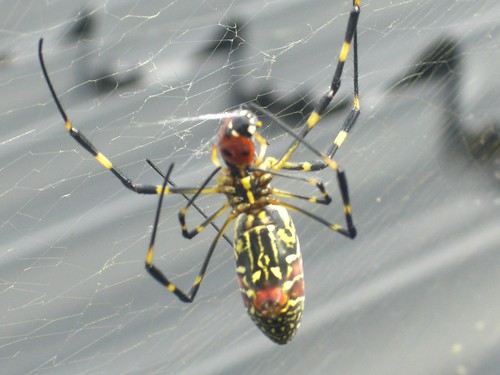
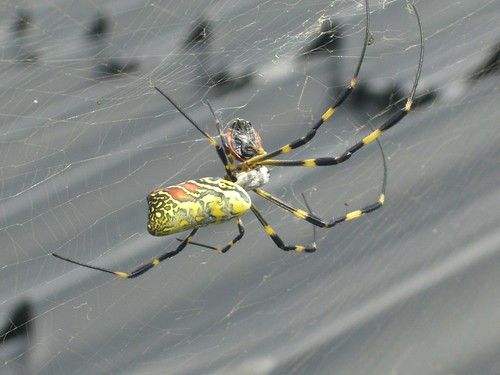
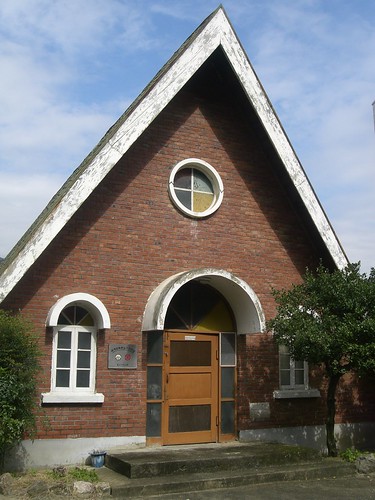
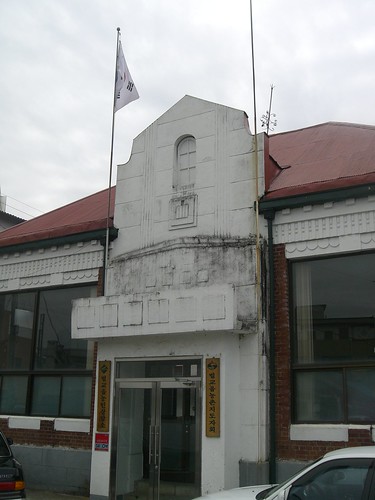
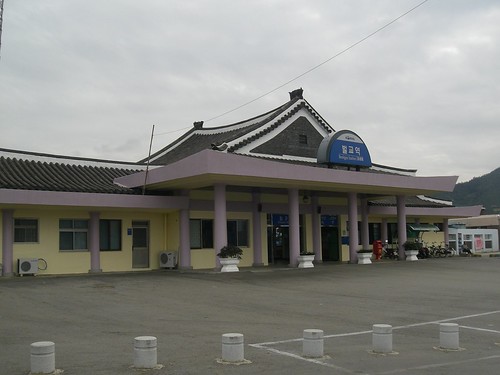
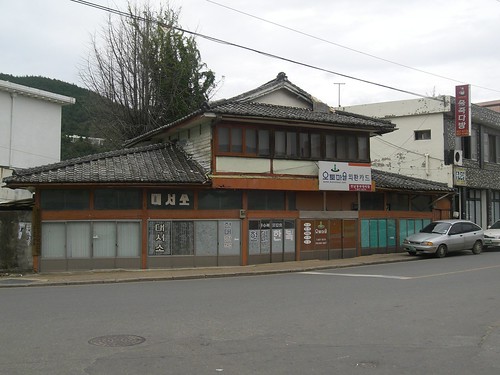
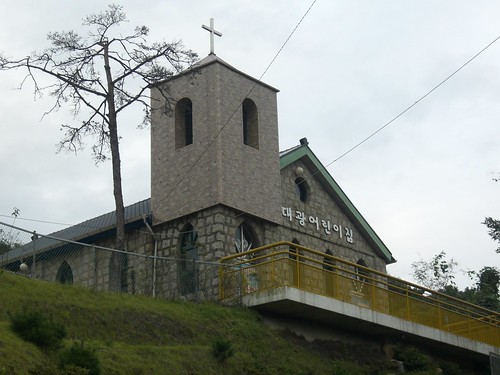
Overall it was a pretty rotten trip, but I'll talk about that below. Here are some pictures, sans captions. For some reason, the spacing and text get screwed up whenever I preview, and what looks like one space here becomes three spaces in the published version. After about four tries, I've given up on explanatory captions, and instead refer you to my flickr page for more information. Here are photos of: Rainbow Bridge, Beolgyo Pogyodang, a Joro spider, an abandoned church, a view of Beolgyo from Buyongsan Park, the Financial Collective building, Beolgyo Station, another Japanese-style building, and Hoejeongni Church.


There are 40-some pictures on my flickr page, and further information about these sites, or about a Beolgyo self-guided walk-through can be found on the Galbijim page.

Anyway, the trip was pretty shitty. The tourist map I was able to find hanging in town said "you are here," but I was not "here." It took me a long time to realize that the map had been moved some 5 blocks away, a big difference in a small town. The map showed the location of 16 sites from Taebaek Sanmaek, though I was only able to find 7. The small mountain, 부용산 (Buyongsan) had maps along the trails, but they seemed more for decoration than for guidance, and basically pointed in contradictory ways. And, I had to put up with pretty aggressive and abusive behavior from some of the local students. Screams of "Fuck you," curses and taunts in Korean, the finger, and having a tennis ball thrown at me made me really happy to finally get back to the bus terminal.

Korean students tend to be disrespectful to foreigners as their default behavior. Unless they are taught to act otherwise, its fairly common to get shouted at, to get pelted with "하이이이이" (mispronounced "hi"), "hello," "hey," "you," "and other misused salutations. I teach my students how to greet me on the first day of school, and I don't tolerate "hi," "hey," "you," "come here," or "hello," nor do I respond to people shouting my name. I've been with plenty of foreigners who consider this behavior cute, or polite, or a demonstration of Koreans' curiosity, or interest in English, or interest in foreigners, and I've seen it explained in journals as a liberating experience, as English does not have the various speech levels Korean does (thus many Koreans incorrectly assume that politeness need not be minded in English). I ignore the "hi"s, and "hello"s, and "나이스투미츄"s on the street, and I always request that Korean speak to me in Korean. Sadly, I've been around foreigners who respond to every piece of shit who yells "hi" at them, and it sort of undermines what I'm doing. Anyway, I'm not sure exactly how the habit of shouting at foreigners came about, but it's one I try not to encourage.

Update: A write-up I did for the Gwangju News was published in the October, 2007 edition. Click here to visit their page, which links to a .pdf file of the October issue.