Here's another old house in the area that may or may not be in the Japanese-style, I can't really tell. It's a block or two south of Suncheon Hyanggyo (순천향교, one of the Confucian academies), so not actually in Maegok-dong, but I thought it looked neat, regardless.
Friday, January 11, 2008
Japanese homes in Maegok-dong.
Here's another old house in the area that may or may not be in the Japanese-style, I can't really tell. It's a block or two south of Suncheon Hyanggyo (순천향교, one of the Confucian academies), so not actually in Maegok-dong, but I thought it looked neat, regardless.
Tuesday, January 8, 2008
Missionaries in Suncheon

An earlier incarnation of Jungang Church, est. 1907, in Maegok-dong. The photo was stolen from here.
I've rushed this entry a bit, and wasn't as thorough as possible in a few spots, because I wanted to get something out before I go out of town for most of the rest of January. I've been sitting on this post for over a month, and I'll have to do a little more digging later. This also isn't meant to be exhaustive or authoritative . . . I was just curious about some stuff around town, that's all.
I first wandered through Maegok-dong in late-November, when I was looking for some information about a monument to the Yosu-Sunchon Incident that was supposed to be there. Maegok-dong is just west of Suncheon's Old Downtown, just across the Medical Rotary (의료원 R) from McDonald's and Bukbu Market. I don't know the exact boundaries of Maegok-dong, but it occupies 1.42 square kilometers and includes the medical rotary in the south, the university in the north, and in between reaches a few blocks west of Jungang-ro (중앙로). According to Naver it had a population of 10,309 in 2001, but according to the Maegok-dong website, that number decreased to 7,421 four years later. In 1931, Maegok-ri was incorporated in Suncheon-eup (eup/읍 means town), and when Suncheon-eup became Suncheon county in 1949, Maegok-ri was elevated to a dong/동, a larger administrative division.It's an interesting little neighborhood, with lots of little alleys, homes seemingly piled on top of one another, a couple of Confucian academies, a few crumbling Japanese-style homes, and several big schools. (Okay, so it's probably like a lot of other Korean neighborhoods, but I'm easily amused.) Anyway, turns out it was also one of the first places in the region to host American missionaries.

(Top) A picture of a village in Maegok-dong, circa 1913. Really remarkable. I stole it from this Naver blog, but I wanted to upload it myself in case the other blog went down. (Bottom) Old picture of Western-style buildings in Maegok-dong. The one on the left was a hospital that is no longer there. This photo, along with about a dozen others, are on dislpay in an alley across the street from Suncheon National University.
A timeline* at the Historical Museum of Korean Christian Mission (sic) (한국 기독교 선교 역사 박물관) in Suncheon says that missionaries were first dispatched to the southern region---the two Jeollas and Chungcheongnam-do---in 1893. In February, 1893---according to the timeline, anyway---Reverend William Davis Reynolds and Reverend Lewis Boyd Tate arrived in Jeonju and stayed for two weeks. Dr. Alexander D. Drew, M.D., arrived the following year and was the first medical missionary to the country. The timeline continues to mention that Reverend Reynolds and Tate toured the Jeollas in March, 1894, making trips to Gunsan, Yeosu, Suncheon, Mokpo, and other lesser-known towns and counties. In March, 1897, Reverend Eugene Bell established Yangdong Church (양동교회) in Mokpo, apparently the first church in the Honam region. In 1901 Fredrica Straeffer started teaching girls in Mokpo at what would become Jeongmyeong Girl's High School two years later. Incidentally, that school's website has a small gallery of pictures from the early 20th century here. Also in 1903 in Mokpo, the Youngheung School, known today as Yeongheung High School (영흥고등학교), was established. In commermoration of the 100th anniversary a few years back, the school put together a newsletter with a bunch of articles (in Korean) and some pictures of campus buildings through the years. It is available as a .pdf file here. There is also a gallery with 81 pages of photos of people, events, and buildings through the years, available here.
Getting back to Suncheon, the timeline is actually a little vague about initial efforts in the city. As mentioned the two early missionaries made a tour of the Jeollas and stopped in Suncheon in 1894. The next mention is in 1909, when "John F. Preston and Rev. William D. Reynolds suggested a station in Soonchun." The following year, Deacon Yoon Soo Kim (김윤수) bought ten acres of land "which was named Mai-san-deung"---매산 등, currently occupied by the three Maesan schools and the old seminary---"with the help of Mr. Eok-pyung Kim of Soonchun-Eub Church (now Soonchun Central Church)." If you happened across Suncheon Central Church (순천중앙교회) in December, you'd know that it's celebrating its "101th Christmas" (sic), and the church website confirms that the church was founded in 1907 by John F. Preston. The building that stands now was finished in 1983, but in front of the main entrance is a small statue with a plaque of J. F. Preston.

Another old picture of Central Church, the second incarnation, I believe. I don't remember where I stole this.
Reverend Preston would have a hand in founding three other local points of interest: Maesan Middle School (매산중), Maesan High School (매산고), and Maesan Girls High School (매산여고). All three are private Presbyterian schools founded in 1910 by Preston and Robert Thornwell Coit. Maesan Middle School made the news last year when a bus crash claimed the lives of 5 students on Jirisan. There are a few older Western-style buildings on the campus, although I don't know exactly when they were built, and quick searches for cornerstones turned up nothing. If you start from Jungang Church and walk past the clinic and up the hill, you will first pass the middle school, then the girls' high school, then the high school. In between the girls' high school and middle school is the site of the old seminary. On the campus of the middle school, bordered on two sides by a construction zone, is a large Western-style building presently used as the library and probably for other things, too. The girls' high school has two Western homes, one on each end of the playground. The most dominant feature on the high school campus is a large, brand new gymnasium that you can see from a few blocks away.
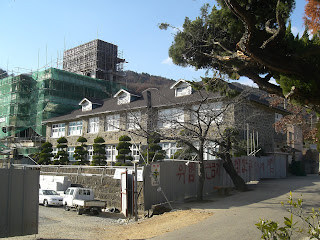
(Top) Large building on the campus of Maesan Middle School. (Middle) Old, one-time house at the entrance of Maesan Girls' High School. Currently the "교목실." (Bottom) Old building at the opposite end of Maesan Girls' High School.
I mentioned the clinic and museum, located right behind Central Church. The clinic (순천기독진료소) was established in 1960 by Lois F. Linton and is located on the first floor of a Western-style brick home. On the second floor is a small museum with a collection of photographs, letters, and other artificats of and from early missionaries not only to Suncheon but to other cities like Gwangju, Yeosu, Mokpo, and Jeonju. On the third floor is a cozy little apartment with furniture dating to the mid-20th century. I was pleasantly surprised by the museum, and its worth a visit if you're in the area. There isn't much English, though, and I'm sure the trip would have been much more useful could I understand more of the displays. Anyway, when you get there you'll have to first stop into the clinic and ask them to unlock the door.
The clinic and museum, behind Central Church (중앙교회).
The clinic there is one of three related tuberculosis (결핵) care facilities set up in Suncheon by American missionaries. There is also a "rest village" (요양원) a bit east, and the "Lois Village" (보양원) in Haeryong-myeon. You may be able to glean a little more information from the official site, stoptbkorea.com. A couple blocks west of the schools is a care facility called 애양재활원. I haven't been able to find any information online about this at all, and I don't know what it does or what, if any, relation it has to the other care centers in the area. There are a few Western-style buildings on the site, though, although I don't know how old or authentic they are.
A building at a care center (애양재활원) a few blocks west of the three Maesan schools.
While doing a little write-up on Missionary Wilson's House in Gwangju I came across some familiar names. For example, the Reverend Thomas Dwight Linton served as principal of the Honam Theological Seminary from 1973 to 1978. That seminary was formed when the Honam Bible School, the Suncheon Maesan Seminary, and Gwangju Night School merged in 1961, and is known today as Honam Theological University and Seminary. The HTUS campus includes a small hill, on top of which is a cemetary where many early missionaries and their family members are interred. Among those at that cemetary is Eugene Bell, who first arrived in Korea in 1895 and who established the aforementioned Yangdong Church in Mokpo in 1897. His wife died in 1901 and is buried at the Foreigner's Cemetary in Seoul. One hundred years after his arrival in Korea, the EugeneBell Foundation was established to provide medical and developmental assistance to North Korea.
It was founded by Dr. Stephen Linton, great-grandson of Eugene Bell. He has a very sloppy wikipedia page here. His brother, Dr. John Linton, is director of Severance Hospital International Health Care Center at Yonsei University, and is one of the most notable foreigners in the country, if you could even call him a foreigner at this point. There is a little interview with Dr. Linton here, from the Tour2Korea website. [Update, March 11: Thanks to The Marmot's Hole for the tip about an article in the Washington Post on Dr. Linton and his work in North Korea.]
Another group with familial ties to the original settlers that provides assistance to North Korea is Wellspring, a project out of the Western Carolina Presbytery in North Carolina. The "Ruling Elder" is James Linton, another great-grandson of Eugene Bell. The Wellspring homepage says that Mr. Linton's father founded some 165 churches in Korea.
The relative youth of these "old" buildings in Maegok-dong is something that struck me when I first learned about all those buildings on campus, and even back when I visited the Wilson House in Gwangju. These structures date to the early-20th century---the Wilson House to 1920---and are some of the oldest buildings in the region. But all the houses in my grandparents' neighborhood in Pittsburgh are older than these buildings, and I chuckled a little when I realized I was taking pictures of buildings that wouldn't attract the slightest bit of attention back home. That's the way Korea is, and because of wars, invasions, natural disasters, and neglect, it's not uncommon to have family members older than historical sites here. In fact, I'm older than the present-day Nagan-eupseong Folk Village, although there have been different versions of it for 1300 years.
* A lot of the names and dates in this post are based on the timeline. When possible I've tried to check against other online sources. I'm inclined to trust the timeline, although because the romanization and the Western names are a little inconsistent, and some known facts aren't included, we can't be sure that other information is completely accurate.
Monday, December 31, 2007
이번역은, 율촌, 율촌역 입니다 ~ Yulchon Station

Front of Yulchon Station.
While looking for an article I read years ago about the remotest train station in South Korea, I came across a little mention of Yulchon Station in Yeosu city. Built in 1930 it was one of 12 small train stations designated as cultural properties in 2006. According to the Joongang Ilbo:
Further south in the countryside is Yulchon Station (1930) in Yeosu, South Jeolla, which was built during the Japanese colonial period and is a wooden facility typical of those commonly found in the Japanese countryside.
During an interim study on the project, researchers faced complaints that the government was trying to preserve a “leftover from the Japanese colonial era” but they decided the facility had value culturally and from a architectural perspective, so it was included on the list.
I visited Yulchon Station back in September, back when I was doing write-ups of defunct Jeollanam-do train stations for Galbijim, and because I had compiled those since-deleted profiles is the only reason the name jumped out at me. I'm not sure if the station is open to passengers these days. There were two employees inside, manning electrical contraptions, although there was nobody at the ticket window and no recent train schedule. I was able to spend a few minutes wandering through it and snapping pictures on both sides of the platform, something unthinkable back home.

Back of Yulchon Station.
The station is located in Yulchon-myeon (map), an administrative division of under 10,000 people in western Yeosu. It borders Suncheon on the west, and is one of many expanses of rural, undeveloped land that would fill in between the urban centers of Suncheon, Yeosu, and Gwangyang, should the merger take place. Also a reminder that village life and its various charms---not being facetious---is never too far away from anything in Jeollanam-do. Not sure too many people needed that reminder, as there are vegetable gardens growing across the street from Gwangju City Hall.

Field overlooking the village center.

"No, no, no, I said PRAY with Jesus."
By the way, I never found the article about the remotest train station in Korea. If I remember correctly it's somewhere in Gangwon-do, and the article talked with two guys who had to man this station way up in the mountains. If anyone knows what I'm talking about, could you please pass it along?
Thursday, December 13, 2007
Sisters of Charity

No disrespect intended, but when this first popped up on their website I thought they were worshipping an electrical box.
Foreigners were scarce in Gangjin county, and I was thrilled to meet a fellow American there last year, a nun, working at a girls’ high school. Turns out the school was affiliated with the Sisters of Charity of Seton Hill (사랑의씨튼수녀회) and Seton Hill University, located an hour or two east of Pittsburgh.
Volunteers were first invited to the Jeonnam area in 1960, and in 1962 St. Joseph’s Girls’ High School opened in Gangjin.
Google didn’t bring up too much on the Sisters of Charity in Gwangju or Jeollanam-do, although I did come across two interesting pieces. One is a Seoul Times interview with Pittsburgh native Sister Jane Ann Cherubin, who first came to Korea with the Sisters in 1976. I also came across a collection of poems (in .pdf form) “physically and visually impaired children attending schools run by the Sisters of Charity of Seton Hill in Gwangju and Chungju,” translated by Brother Anthony of Taize.
According to this page the Sisters of Charity operate a few community centers in Gwangju, about which I couldn’t find much. Koreabeat does translate an article about the “Blue Eyed Guardian Angel,” Patrick O’Neal, a 75-year-old Irish priest who has been in Korea since 1957. An excerpt:
He came to Korea in 1957. The Priest from Ireland came to Korea the year following his ordanination as a priest assigned to the Saint Columbanus Church. Starting his post as the head priest at Gwangju Cathedral in 1969 he realised the condition of the mentally handicapped people housed in the Mudeung Rehabilitation Centre with unfavorable facilities and made a new resolution. He was especially sad about the death of a mentally handicapped young girl in 1979. “As soon as the girl with the name Yoa died from acute pneumonia instead of the funeral expenses the hospital demanded the body for dissection.”
Accordingly the Priest rejected this in one line “as she lived she couldn’t receive humane treatment and even though she has died you can’t do this.” Despite this after she was buried in the Yangsan Church Cemetary he said to the grave “Are you going to forgive me? Are you going to forgive society? For a long time he impressed on himself the words “I disregarded you” and repented through tears. The priest still tidies up Yoa’s grave with his own hands.
Monday, December 10, 2007
Sunchon Tunnel Massacre - October 30, 1950

Suncheon is also the name of a city in North Korea, something I was reminded of while googling "Sunchon" in order to find older mentions of the South Korean city. The North Korean city has a population of 437,000, and though it is spelled the same in Hangeul, it, along with the rest of the DPRK, uses the McCune-Reischauer spelling of Sunch'ŏn. Anyway, I bring it up because while I was googling I came across a few sites talking about the Sunchon Tunnel Massacre, which I had never heard of before. According to U.S. Senate Report no. 848 on Atrocities of January, 1954:
In October of 1950, at Pyongyang, when the fall of that city appeared imminent, the Communists loaded approximately 180 American war prisoners into open railroad cars for transport northward. These men were survivors of the Seoul-Pyongyang death march and were weak from lack of food, water, and medical care. They rode unprotected in the raw climate for 4 or 5 days, arriving at the Sunchon tunnel on October 30, 1950. Late in the afternoon, the prisoners were taken from the railroad cars in alternate groups of approximately 40 to nearby ravines, ostensibly to receive their first food in several days. There they were ruthlessly shot by North Korean soldiers, using Russian burp guns. One hundred and thirty-eight American soldiers lost their lives in this atrocity; 68 were murdered at the tunnel, 7 died of malnutrition while in the tunnel, and the remainder died of pneumonia, dysentery, and malnutrition while in the tunnel, and the remainder died of pneumonia, dysentery, and malnutrition on the horror trip from Pyongyang.
You can also find the above report here, in .pdf form. According to another report, almost two-thirds of American prisoners of war who died in Korea died of war crimes. I found that report through a link from Wikipedia's Korean War page which, to me, seems a bit biased against the US.
Anyway, it's fairly timely because apparently a book was just released which documents the accounts of eight survivors. It is called They Came Home - Sunchon Tunnel Massacre Survivors.
MIssionary Wilson's House, Gwangju


It was home to the American missionary Robert A. Wilson, about whom I've been able to find no further information. It is located on the campus of the Honam Theological University and Seminary, on the other side of Sajik Park. On the site of present-day HTUS, the Honam Bible School was established in 1955 by American Presbyterians. In the early 1960s, the Honam Bible School merged with the Gwangju Night School and the Suncheon Maesan Seminary to form the Honam Theology Institution.
According to the HTUS site, the Reverend Thomas Dwight Linton served as principal of the Honam Theological Seminary from 1973 to 1978. The Linton family, it turns out, has an interesting history in Korea, especially in Suncheon, that continues to this day.
The above-mentioned timeline also tells us that George Thompson Brown was the first principal of the Honam Theology Institution, from 1961 to 1967. I don't know anything about him either, but google says he published a 30-page pamphlet titled "Not by Might: A Century of Presbyterians in Korea" in 1984. While
Wilson's house is on the campus of HTUS. It is on the left side of this map, although I don't recall if it's the "Missionary Compounds" labeled 17. If I remember correctly it is located further down the path, beside a cafe, and is really quite isolated. It is not open to the public and, in spite of being a monument and historical site, is in pretty bad shape, with broken windows and litter inside the first-floor rooms. The basement door was wide open when I was last there, though it was empty of anything besides spiders and trash.
Sunday, December 9, 2007
Lee Hak-rae (Kakurai Hiromaru)
He has lived in Japan since his release, and has been fighting for compensation for the Koreans forced to serve in the Japanese army. He had his group of Korean ex-collaborators sued the Japanese government in 1991, but the case was thrown out. From a Japan Times article from August of this year, "I will continue our activities until the government shows sincere remorse. This problem will not end even after all of us die," Lee said. "Our following generation will keep raising this issue."
I was reminded of last year, when the "Republic of Korea’s Truth Commission on Forced Mobilization Under Japanese Imperialism" cleared 83 of the 148 Class B and C Korean war criminals of any wrongdoing and responsibility for their actions during World War II.
He receives pretty sympathetic treatment in the Hankyoreh:
"I cannot deny that the prisoner camp conditions were deplorable," said Lee. Food, medicine, and clothes were not properly provided, and many forced laborers lost their lives due to wounds and diseases that went untreated. In the month of March 1943 alone, a full quarter of the 800 Australian prisoners were hospitalized. One hundred died. For good reason, the Australian military prosecutors could not forgive the Japanese for putting their men through hell on Earth. They were eager to pursue those responsible for the deaths of their comrades, but in their fury were not about to lend an ear to the plight of a youth caught up in the gears of the imperial war machine.
I suspect many who lost their lives in this and other wars were youths caught up in a war effort well beyond their control. Whether you believe them or not, most Japanese accounts of the time will tell you the same thing. Hell, the whole business of reconstruction sought to avoid the responsibility question by placing the blame squarely on an out-of-control military machine. But not before millions died as a result. I'm not being an apologist by any means, and I find the denial of responsibility by the Japanese quite repulsive. Moreover, this issue speaks to the plight of non-Japanese in Japan, and racism was a huge part of the Empire's push to unify Asia. Let's not forget, though, that war is a repulsive thing that annihilates entire generations of people. Very few would find glory and honor in being mutilated were it not for books, movies, epic poetry, and life insurance policies telling us this is the way to go.
The article continues:
Lee served as a supervisor of the prisoners at Hintok. As a civilian hired by the Japanese military, he was lower down on the chain of command than a private.
However in the trial proceedings, he had somehow been transformed into the "Camp Commandant." The reason for this was that the military prosecutors took the testimony of the prisoners at their word, without an objective investigation into the situation. Most of the Australian prisoners did not know Lee’s Japanese name. Instead, they gave the various guards nicknames, which in the case of Lee was "lizard." The origin of this name is unknown.
And:
According to testimonies of prisoners at the time, Lee was often at odds with the Australian army surgeon and Lieutenant Colonel E. E. Dunlop as he tried to meet the demands of the Japanese engineer corps to deploy laborers. Dunlop insisted that wounded soldiers not be used. The prisoners soon developed an animosity toward those Koreans directly overseeing them. Soldier Austin Pipe recounted that "lizard" was responsible for sending prisoners to work on the railroad, and others recalled that Lee had assaulted Dunlop. But other prisoners testified that Lee was among the gentler of the guards and had not assaulted Dunlop. For example, Captain Richard Allen testified that he could not recall Dunlop ever having been attacked by Lee, and that Lee was less brutal than the other guards. However, the vast majority of the testimony was unfavorable toward Lee. In order to sort out the war criminals, Australian investigators took pictures of the prison guards and showed them to the POWs. Those suspected of war crimes were then arrested and put on trial. There were no cross-examinations. Lee admitted to slapping those who disobeyed the rules, but denied taking any other harsh measures. It was difficult to gauge just exactly how much authority was granted to the Korean youth.
Lee was 20 years old when he was put on trial, and fearful of what lay before him. He feigned ignorance before the judge, and damaged his trustworthiness by insisting that daily labor was limited to five-and-a-half hours. Though his lawyer insisted the charges be dismissed on account of his not being Japanese, the judge rejected this argument - also backed up by the testimony of a Japanese colonel named Ishi - that as a Korean civilian, Lee’s actions were merely the product of his Japanese superiors’wishes.
The Hankyoreh article talks about a few other Korean men sentenced to death, and ends with this paragraph:
There were few who welcomed him upon his release. His homeland viewed him with suspicion as a pro-Japanese collaborator, and the Japanese ostracized him for his Korean ethnicity. Thus, his struggle continues to this day. "If only for the sake of my fallen comrades," he said, "I hope that our honor will be one day restored." Beneath the sunlit sky, his moderate Jeolla Province accent was as distinct as ever.
I find the whole business of "truth and reconciliation" ridiculous, because it's just a bunch of nonsense aimed at discrediting the political enemies of the day. You'll notice a lot of these committees come to the same conclusion: "It wasn't me." But, especially when we remember his life was spared on appeal and his sentence greatly reduced, Lee comes off as an especially large piece of shit for his insistence for being paid . . . for something he didn't do . . . was forced to do . . . volunteered to do . . . wait.
From the Japan Times:
When Japan signed the 1952 San Francisco Peace Treaty, restoring its sovereignty, Koreans were stripped of the Japanese citizenship they had been forced to adopt during Japan's colonial rule."Japan forced Koreans to participate in the war (as Japanese) but then refused to pay us compensation because (we were suddenly no longer Japanese citizens). That's irrational," said Lee, who now runs a taxi company in Tokyo. "The government's attitude is unforgivable."
Please correct me if I'm wrong, but didn't Korean citizens lose the right to sue the Japanese government for compensation when Park Chung-hee normalized Korea-Japan relations in 1965? I can't find a link now, but if I remember correctly the lump sum Park and his government were paid preclude individual claims?
Anyway, after googling around I see Japan Probe picked up the story in August. One commenter had a nice quote:
It’s interesting how articles of this sort always refer to Koreans having their citizenship “stripped” in 1952. Isn’t that a bit similar to, say, “After the War of Independence was won, General Washington and his troops were stripped of their British citizenship”? It definitely implies forceful removal, generally removal that goes against the wishes of the stripped person (this may not apply to pole dancers, however). Why do so few articles say “Koreans had their citizenship restored”? Am I paranoid to suspect that the wording is chosen to make Japan look bad? The article quoted here is a classic case: “stripped of the Japanese citizenship they had been forced to adopt” - can’t win.
TIME magazine on the 1948 Yosu-Sunchon Incident.
First is an article from November 1, 1948, titled "From One Source."
One day last week, Radio Moscow announced that Russian troops had begun to pull out of North Korea. On the same day, a Communist-inspired revolt broke out in Korea's southern tip.Next is a report from November 8, 1948, filed by Carl Mydans, who was accompanying the government troops.
The Russian withdrawal in the north worried South Koreans more than did the vest-pocket southern uprising. The Russians were leaving behind them a firmly installed Communist regime with a well-trained army of 150,000. The departure of the Red army was intended to bring pressure on the U.S. to withdraw its troops, leaving a South Korean constabulary and militia totaling about 60,000 to face the far stronger northern force.
Dr. Syngman Rhee, President of the two-month-old South Korean Republic, was in Tokyo visiting Douglas MacArthur at the time. Said MacArthur: "I will defend Korea as I would my own country—just as I would California."
With MacArthur's words to encourage them, the South Korean army energetically set about crushing the revolt. It had begun one morning before dawn, when 40 Communist members of a brigade stationed in the far southern port of Yosu shot their officers and bullied their sleepy comrades into attacking the city police station. They took over all of Yosu, then headed north, picking up confused recruits along the way. By the time they reached Sunchon, a city of 75,000, their force had grown to
around 2,000.
Brigadier General Song Ho's loyal troops quickly drove the rebels out of Sunchon, and chased them back into the rough, hilly country to the south. It was hard to tell friend from foe. Both loyal and rebel troops wore U.S. uniforms and carried U.S. weapons. Loyal troops finally put on white armbands. Said young Lieut. Colonel Kang Yung Noon: "What sadness that we had to fire our first bullets against our own brothers."
At week's end government forces had retaken most of the territory won by the rebels; they expected to recover Yosu soon. Asked who was responsible for the revolt, President Rhee said: "We really do not know." Then he pointed a finger to the north and added: "But all of our troubles come from one source."
The pretty little valley of Sunchon ("Peaceful Heaven") rests neatly at the bottom of the rugged Chiri Mountains, twelve miles north of the port of Yosu. On the morning of Oct. 20, Sunchon's farmers were harvesting their rice, when they heard a siren and the rattle of small arms from the railroad station. They looked up to see 2,000 rebel soldiers and 400 civilians swarming off a train from Yosu.
The rebels approached Sunchon city peacefully; but as soon as they entered the city, police opened fire. Joined by a company of soldiers guarding the city bridge, the rebels fired back. After a short, sharp battle they were in full control. The hundred or so cops who surrendered were lined up against the wall of the police compound and riddled. Then the rebels, joined by part of the citizenry, paraded through the city under North Korea's Communist banner, singing "Ten thousand years to the North Korean People's Republic!"
Star-Spangled Shirt. When darkness came, Communist execution squads went from house to house, shooting "rightists" in their beds or marching them to collection points where they were mowed down. In 2-3-days, 500 civilians were slaughtered. U.S. Lieuts. Stewart M. Greenbaum and Gordon Mohr, Army observers in Sunchon, narrowly escaped death. The rebel sergeant assigned to kill them was an old friend, who had drunk beer with them in their billet many times. He took the two officers into a field, fired into the ground and then led them to the Presbyterian Mission of Dr. John Curtis Crane, who was barricaded in with his wife and four other missionaries.
From one of the doctor's shirts and a few colored rags the ladies made a 16-star, eleven-stripe U.S. flag and put it up. The rebels began pounding at the compound gate, yelling: "Let's kill the Americans!" Suddenly one shouted: "No, no, not them; they are my friends." It was the lieutenants' friend, the sergeant. The rebels went away.
For the first few hours the loyal troops who retook Sunchon were as savage as the Communists had been. On the big compound of the Sunchon Agricultural and Forestry School we found what was left of the entire population of Sunchon. Women with babies on their backs watched without expression as their husbands and sons were beaten with clubs, rifle butts and steel helmets. They saw 22 of them marched away to the primary school nearby, and heard the volley of rifles which killed them.
"Get the Americans Out." Two days later, entering Yosu, the town where the revolt began, the government troops were much better behaved. The Communists' occupation of Yosu revealed the pattern they would like to impose on all South Korea. After arrest and murder of police and loyal leaders, the rebels took over all communications, banks, schools and food distribution. They established a "People's Committee" as the new government. The "People's Committee" announced: "Our two-point program: 1) to oppose, to the death the killing of our brothers, and 2) to get the Americans out of here."
Though the recapture of Yosu has temporarily stalled the revolt, most of the rebel troops have, melted off into the countryside and mountains with their weapons. Yosu's fall was not the end of a war; it was only the beginning. The general civilian point of view was expressed by one woman we found squatting in a shack on the outskirts of Yosu just after the fight had gone by her door. When we asked her whom she was for she replied: "I'm for you. You are the strongest."
The Suncheon Agricultural and Forestry School is present-day Suncheon National University. A few days ago I posted about the placards around Suncheon that mark notable sites during the rebellion. The one on the campus reads:
At the time of the Yosun Incident, the quell force, made up of police and defense guard troops, used the Suncheon Middle School of Farming and Forestry (the predecessor of the present Sunchon National University) as their camp and headquarter when they attacked the insurgent forces in downtown Suncheon on Oct. 22th. The nearby Suncheon Northern Elementary School was the site of questioning and executing of civilians who were suspected of taking sides with the insurgents. The victims were executed without trial on the levee of a rice paddy behind the school's auditorium.
There are a few articles on the rebellion from the New York Times. I thought their archives were free, but since they're not, I can't get to them. Anyone interested can comb through these search results.
Thursday, December 6, 2007
Placards about the Yosu-Sunchon Incident around Suncheon (여순사건관련지)
I've come across a few placards around Suncheon marking notable places during the Yosu-Sunchon Incident of 1948 (which also known as the Yosu Rebellion, the Yosu-Sunchon Rebellion, and other variations). I haven't found many internet sources in English on the internet, so I find these placards kind of useful. I'd also be interested to know what happened during this time---between World War II and the Korean War---in other areas of Jeollanam-do (specifically Gangjin). Anyway, for a little background on the incident, there are two articles here and here.
I've come across three placards so far: at Suncheon Station, at Dongcheon River, and at Suncheon National University. I originally assumed 관련지 meant "placard," but looking in the dictionary I see "관련" means "relation, connection, association." All three of the placards marking sites associated with the incident are two-sided, and all three contain the following text on one side:
The Yosun Incident broke out on Oct. 19, 1948, when the 14th Regiment of the National Defense Guard of South Korea refused to move to Jeju Island on a mission to put down an armed uprising protesting against the estasblishment of the government by South Korea alone. When about 2,000 soldiers marched into downtown Yeosu, the civilians,students and local leftists, who were suffering from economic distress after the establishment of the new government, joined the soldiers. The insurgent forces instantly occupied eastern areas of Jeonnam Province, i.e., Suncheon, Gwangyang, Gurye, Boseong, Goheung, and Gokseong. The government established the quell force headquarter in Gwangju and defeated the insurgent forces in Suncheon on Oct. 23 and in Yeosu on Oct. 27. During the search operation against the civilian collaborators, many innocent civilians were executed without trial. The number of victims of the Yosun Incident is estimated to be about 10,000 including policement, soldiers, and civilians, though the exact number is not known.I didn't change any errors in spelling, punctuation, grammar, or spacing, and I didn't alter any of the romanization.
The Yosun Incident served as a momentum for establishing 'anti-communism' as the national idiology for South Korea and fixation of the partition of the Korean peninsula.
On the flip side of the placard in front of Suncheon Station is the following:
Suncheon Station bore witness to the early stages of the Yosun Incident. The insurgent forces used Suncheon Station as a base to attack downtown Suncheon while they were extending their influence outside Yeosu. At 8:39 Oct. 20, 1948, abotu two thousands of the insurgent forces left Yosu by train and other vehicles, and arrived at Suncheon Station at around 09:30 without facing any resistance. Two companies of the 14th Regiment, which had been dispatched to Suncheon, joined the insurgent forces under the command of 1st Lt. Hong Soonsuk. The joint forces were able to easily break through the resistance of the police troops who were defending Gwangyang Saguri (a three forked road) and the bank of Dongchun Stream, and advanced toward downtown Suncheon. The current building of the Suncheon Station was rebuilt in October, 1960.The placard on the banks of Dongchun/Dongcheon is about 15 minutes away. From Suncheon Station, walk west toward the river. Follow the pedestrian on-ramp to your right and start walking north along the river. It is on the east side of the stream, along the walking path, tucked under Suncheon Bridge (순천교).
The placard reads:
The Suncheon Bridge (Jangdaedari) and the bank of Dongchun Stream witnessed the first fierce combat between the police and the insurgent forces at the time of the Yosun Incident. On October 20th, the Suncheon police and right-wing youths from adjacent regions established a defensive line at Gwangyang Samguri, but failed to keep the insurgent forces from advancing to downtown Suncheon because the 4th Regiment, a support troop from Gwangju, joined the insurgents. During the combat, most of the policement escaped from the spot, some were killed, and only about 50 retreated to the Suncheon Police Station.
The third placard I found is located on Suncheon National University, behind the graduate school / language center (대학원 / 어학원), number 2 on this map. If exiting the building, turn left and at the street turn left, and the placard will be visible a few meters on your left.
The placard says "여순사건관련지 - 순천농림중학교 (현 순천대학교), or Suncheon Middle School of Farming and Forestry (presently Suncheon National University). According to the Suncheon University site, the Farming and Forestry middle school was established in 1946, became a high school in 1951, a vocational high school in 1965, a technical college in 1973, a college in 1979, a four-year college in 1982, and finally Suncheon National University in 1991.
The placard reads:
At the time of the Yosun Incident, the quell force, made up of police and defense guard troops, used the Suncheon Middle School of Farming and Forestry (the predecessor of the present Sunchon National University) as their camp andSuncheon Northern Elementary School (presently 전남순천북초등학교) is located about a half-kilometer south of Suncheon University.
headquarter when they attacked the insurgent forces in downtown Suncheon on Oct. 22th. The nearby Suncheon Northern Elementary School was the site of questioning and executing of civilians who were suspected of taking sides with the insurgents. The victims were executed without trial on the levee of a rice paddy behind the school's auditorium.
Tuesday, December 4, 2007
Suncheon's 국도극장
It's located next to the Lotteria, although if you look at this map from Naver, you'll see that the Lotteria is in the wrong place. The Lotteria, and the theater, are next to the 의료원, about 240 meters north, which is why I'm convinced the theater is actually one of the two dark masses you'll see appearing just east of "서인과" up there. Anyway, the one-screen theater is pretty small, and if you trust the crude measuring stick on Naver maps it's around 30 meters long. The theater and Lotteria are a few spots south of McDonald's, which you can see on the map here.
In front of the theater today is an empty, glass-fronted room that used to hold a "Crocodile" clothing store. There's an old-timey poster for the movie "만죽거리잔혹사," a poster that was not there when I first noticed the theater a few months ago.
You'll also see that general admission tickets at the time of the theater's closing cost 5,500 won. One of the few websites I found mentioning the theater was a Naver 지식 answer from January, 2004, so the was either still open or still thought to be open at that time. Running a very rudimentary search with my dumb-ass Korean ability, I see that 5,500 was the going rate in 2003 and 2004, so I guess the theater first closed around that time. The blog entry I just linked is from February, 2004, and it talks about seeing the movie "Ing," which came out in November, 2003, so I wonder if these smaller theaters showed movies that had past their first run. But, to piss on that theory, the movie in the poster, "만죽거리잔" came out in January, 2004.
Anyway, I'd been meaning to post a picture in the old entry I made, but the reason I bring it up today is because, as I had suspected, the theater will reopen. Well, if you trust my judgment and the authority of the lady working at the "로즈버드" across the street.
Wednesday, November 21, 2007
Newest Truth and Reconciliation Committee is in the news.
This part of the country has had a violent 20th century. Before the Korean War, thousasnds were killed in the Yosu-Sunchon Incident (여수사건) of 1948, which was a response to the Jeju Massacre some 7 months earlier (for which President Roh apologized in 2003) which claimed between 14,000 and 30,000 deceased or missing, according to "The National Committee for the Investigation of the Truth about the Jeju April 3 Incident." You can find placards around Suncheon that point out the sites of notable events during the rebellion (in front of Suncheon Station, for example, or behind the language center of Suncheon National University).Chung Nam Sook, 80, said that in December 1950, soldiers of South Korea's 11th Army Division stormed his village in Hampyong, in the southwest of the country, to hunt Communist guerrillas. North Korean collaborators had already fled, but the soldiers rounded up the remaining villagers in a field.
"They told us to light our cigarettes. Then they began shooting their rifles and machine guns," Chung said. "After a while, an officer called out, 'Any of you who are still alive can stand up and go home now.' Those who did were shot again."
Despite seven bullet wounds, Chung survived by pretending to be dead under the heap of bodies. In July, the truth commission called the killings at Hampyong a "crime against humanity" and told the government to apologize and build a monument for the victims.Both sides in the war were accused of killing large numbers of unarmed civilians and of using terror to force people into compliance as villages across the country fell and were retaken.
For instance, South Korean police officers disguised as a North Korean unit entered villages at Naju, near Hampyong, in July 1950, and when people welcomed them with Communist flags, killed 97, the commission said.
As their town changed hands between the rival armies, villagers who had lost family members were quick to settle scores. More than 50 years later, families still hold grudges.
Anyway, the Truth and Reconciliation Committee is apparently just involved in research and investigation and, according to the IHT article quoted above, "unlike the South African agency, Korea's commission has no power to prosecute crimes or grant immunity."
It does, evidentally, make policy recommendations, as the Marmot's Hole ran another story on the very same Truth and Reconciliation Committee. They have recommended that the Korean government take steps to demand compensation from the US for a 1951 bombing in Gyeongsangbuk-do that killed 51 villagers. In the Marmot's words,
I was thinking 36,000 dead, 92,000 wounded, 8,000 MIA and half a century of security guarantees backed up by US troops might be compensation enough. Apparently, I was wrong.Lest anyone forget, a month ago President Roh said that North Korea should not have to apologize for past transgressions. According to him (via Yonhap):
“There is a disparity between (the South) asking (the North) for an apology and inter-Korean reconciliation and cooperation. I want to ask advocates of a North Korean apology if they are opposed to inter-Korean peace,” Roh was quoted by his spokesperson as saying in a meeting with foreign correspondents based in Seoul.Yet another Korean truth commission, we should remember, cleared 83 of 148 Koreans war criminals---as found by the Allies---of responsibility and wrong-doing for their actions in World War II. 37% of Allied POWs perished at the hands of their captors---among whom Koreans were especially notorious---yet that commission found that these men were victims themselves, "saddled," as the Marmot put it, "by the Japanese with responsibility for the abuse of Allied POWs, and hence had to suffer the “double pain” of forced mobilization AND becoming a war criminal." The links to the original Korea Herald article and Michael Breen's Korea Times rebuttal are broken, so instead I'll just quote what Oranckay had to say on it:
“North Korea’s apology (for past wrongdoings) is a difficult question. In case of the end of a war, the loser is supposed to atone for the war damage and be liable for making an apology. But North Korea did not lose the war. It is not legally realistic to demand the North’s apology,” said Roh.
What annoys me is that one hears sympathy for men who would be called collaborators if they had been working in prisons that held fellow Koreans during colonial rule. Their prisoners were (largely) white, however, so they are afforded as much understanding as possible. And they get to be called “victims.”These select few incidents reveal an inability for accurate self-reflection that you often find in matters of history. It's worth revisiting an October article by top Koreanist Dr. Andrei Lankov (via The Grand Narrative blog):
Every foreign resident of Korea is exposed to a number of habitual Korean statements, which reflect Korean ideas about themselves and their nation. Many of these beliefs are true, some are not so well founded, while others are strange — like, say, the well-known tendency of Koreans to boast that their country “has four distinct seasons” as if this is something unusual and unknown to most other countries of the globe.
One such oft-repeated statement is that Korea has always suffered invasions and wars. Koreans often say, “Our history has been tragic, for centuries we have been invaded by powerful enemies and suffered in their hands greatly.” Every visitor to Korea is bound to hear such a remark sooner or later, and most people tend to take it at face value. This statement might correctly describe Korean history of the last one hundred years, but it is hardly applicable to earlier eras.
But why did such a view develop? There might be few reasons, but I suspect that Korean intellectuals of the 1950s or 1960s were shocked by the turbulent natureWe also see this opportunistic attitude of Korean nationalists when it comes to the topic of Japanese collaborators (친일파) and comfort women, although a complete analysis of either issue is well beyond the means of this humble blogger. Suffice it to say, there is a lack of transparency when it comes to Korean history "as told by Koreans" that ranks it right up there with the best the Chinese and Japanese have to offer. I'm skeptical about the potential for any truth and/or reconciliation that may arise in the hearts of the majority of Koreans as a result of any of these committees.
of the last hundred years of Korea history (to be more precise, the period between 1865 and 1960). This came as a sharp contrast to the tranquility and predictability of earlier times. This shock made Koreans believe that their history has always been that difficult and hard. And, of course, Korean nationalists used these feelings for their own gains. But this is another story.
. .