Showing posts with label Gwangju. Show all posts

Wednesday, January 9, 2008

January 2008 Gwangju News.

The January, 2008 issue of the Gwangju News is out, and you can read my articles on the Neil/visa fiasco, the Yeosu Expo, and the Muan International Airport here. You can also view a piece on the Korean presidential election, which reads, in part:
Conservatives openly support the goals of the shareholder class above the needs of the working class. In the United States those for-profit "needs" are now the main reason new laws are made, and must be catered to, by Democrats and Republicans alike, to gain media acceptance, media coverage, and media endorsements. Thus, the U.S. system is entirely corrupted, and few laws are written that are not in direct response to the needs of the wealthy. Multinational corporations, the American Medical Association, and Jewish Political Action Committees have cornered the U.S. government into abandoning 186 different environmental laws, supporting absurd, tragic wars in the Middle East, and enacting trade laws that allow American corporations to seek out and take advantage of the cheapest possible labor, regardless of the harm it does to American workers.

This is a piece on the Korean election, by the way, which was slipped in two weeks after the deadline. How . . . unfortunate.

Tuesday, January 8, 2008

Missionaries in Suncheon


An earlier incarnation of Jungang Church, est. 1907, in Maegok-dong. The photo was stolen from here.


I've rushed this entry a bit, and wasn't as thorough as possible in a few spots, because I wanted to get something out before I go out of town for most of the rest of January. I've been sitting on this post for over a month, and I'll have to do a little more digging later. This also isn't meant to be exhaustive or authoritative . . . I was just curious about some stuff around town, that's all.

I first wandered through Maegok-dong in late-November, when I was looking for some information about a monument to the Yosu-Sunchon Incident that was supposed to be there. Maegok-dong is just west of Suncheon's Old Downtown, just across the Medical Rotary (의료원 R) from McDonald's and Bukbu Market. I don't know the exact boundaries of Maegok-dong, but it occupies 1.42 square kilometers and includes the medical rotary in the south, the university in the north, and in between reaches a few blocks west of Jungang-ro (중앙로). According to Naver it had a population of 10,309 in 2001, but according to the Maegok-dong website, that number decreased to 7,421 four years later. In 1931, Maegok-ri was incorporated in Suncheon-eup (eup/읍 means town), and when Suncheon-eup became Suncheon county in 1949, Maegok-ri was elevated to a dong/동, a larger administrative division.It's an interesting little neighborhood, with lots of little alleys, homes seemingly piled on top of one another, a couple of Confucian academies, a few crumbling Japanese-style homes, and several big schools. (Okay, so it's probably like a lot of other Korean neighborhoods, but I'm easily amused.) Anyway, turns out it was also one of the first places in the region to host American missionaries.


(Top) A picture of a village in Maegok-dong, circa 1913. Really remarkable. I stole it from this Naver blog, but I wanted to upload it myself in case the other blog went down. (Bottom) Old picture of Western-style buildings in Maegok-dong. The one on the left was a hospital that is no longer there. This photo, along with about a dozen others, are on dislpay in an alley across the street from Suncheon National University.

A timeline* at the Historical Museum of Korean Christian Mission (sic) (한국 기독교 선교 역사 박물관) in Suncheon says that missionaries were first dispatched to the southern region---the two Jeollas and Chungcheongnam-do---in 1893. In February, 1893---according to the timeline, anyway---Reverend William Davis Reynolds and Reverend Lewis Boyd Tate arrived in Jeonju and stayed for two weeks. Dr. Alexander D. Drew, M.D., arrived the following year and was the first medical missionary to the country. The timeline continues to mention that Reverend Reynolds and Tate toured the Jeollas in March, 1894, making trips to Gunsan, Yeosu, Suncheon, Mokpo, and other lesser-known towns and counties. In March, 1897, Reverend Eugene Bell established Yangdong Church (양동교회) in Mokpo, apparently the first church in the Honam region. In 1901 Fredrica Straeffer started teaching girls in Mokpo at what would become Jeongmyeong Girl's High School two years later. Incidentally, that school's website has a small gallery of pictures from the early 20th century here. Also in 1903 in Mokpo, the Youngheung School, known today as Yeongheung High School (영흥고등학교), was established. In commermoration of the 100th anniversary a few years back, the school put together a newsletter with a bunch of articles (in Korean) and some pictures of campus buildings through the years. It is available as a .pdf file here. There is also a gallery with 81 pages of photos of people, events, and buildings through the years, available here.

Getting back to Suncheon, the timeline is actually a little vague about initial efforts in the city. As mentioned the two early missionaries made a tour of the Jeollas and stopped in Suncheon in 1894. The next mention is in 1909, when "John F. Preston and Rev. William D. Reynolds suggested a station in Soonchun." The following year, Deacon Yoon Soo Kim (김윤수) bought ten acres of land "which was named Mai-san-deung"---매산 등, currently occupied by the three Maesan schools and the old seminary---"with the help of Mr. Eok-pyung Kim of Soonchun-Eub Church (now Soonchun Central Church)." If you happened across Suncheon Central Church (순천중앙교회) in December, you'd know that it's celebrating its "101th Christmas" (sic), and the church website confirms that the church was founded in 1907 by John F. Preston. The building that stands now was finished in 1983, but in front of the main entrance is a small statue with a plaque of J. F. Preston.


Another old picture of Central Church, the second incarnation, I believe. I don't remember where I stole this.

Reverend Preston would have a hand in founding three other local points of interest: Maesan Middle School (매산중), Maesan High School (매산고), and Maesan Girls High School (매산여고). All three are private Presbyterian schools founded in 1910 by Preston and Robert Thornwell Coit. Maesan Middle School made the news last year when a bus crash claimed the lives of 5 students on Jirisan. There are a few older Western-style buildings on the campus, although I don't know exactly when they were built, and quick searches for cornerstones turned up nothing. If you start from Jungang Church and walk past the clinic and up the hill, you will first pass the middle school, then the girls' high school, then the high school. In between the girls' high school and middle school is the site of the old seminary. On the campus of the middle school, bordered on two sides by a construction zone, is a large Western-style building presently used as the library and probably for other things, too. The girls' high school has two Western homes, one on each end of the playground. The most dominant feature on the high school campus is a large, brand new gymnasium that you can see from a few blocks away.
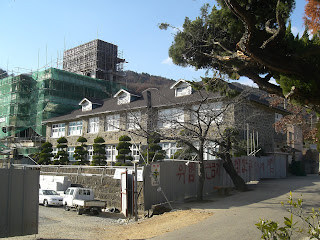


(Top) Large building on the campus of Maesan Middle School. (Middle) Old, one-time house at the entrance of Maesan Girls' High School. Currently the "교목실." (Bottom) Old building at the opposite end of Maesan Girls' High School.

I mentioned the clinic and museum, located right behind Central Church. The clinic (순천기독진료소) was established in 1960 by Lois F. Linton and is located on the first floor of a Western-style brick home. On the second floor is a small museum with a collection of photographs, letters, and other artificats of and from early missionaries not only to Suncheon but to other cities like Gwangju, Yeosu, Mokpo, and Jeonju. On the third floor is a cozy little apartment with furniture dating to the mid-20th century. I was pleasantly surprised by the museum, and its worth a visit if you're in the area. There isn't much English, though, and I'm sure the trip would have been much more useful could I understand more of the displays. Anyway, when you get there you'll have to first stop into the clinic and ask them to unlock the door.


The clinic and museum, behind Central Church (중앙교회).

The clinic there is one of three related tuberculosis (결핵) care facilities set up in Suncheon by American missionaries. There is also a "rest village" (요양원) a bit east, and the "Lois Village" (보양원) in Haeryong-myeon. You may be able to glean a little more information from the official site, stoptbkorea.com. A couple blocks west of the schools is a care facility called 애양재활원. I haven't been able to find any information online about this at all, and I don't know what it does or what, if any, relation it has to the other care centers in the area. There are a few Western-style buildings on the site, though, although I don't know how old or authentic they are.


A building at a care center (애양재활원) a few blocks west of the three Maesan schools.

While doing a little write-up on Missionary Wilson's House in Gwangju I came across some familiar names. For example, the Reverend Thomas Dwight Linton served as principal of the Honam Theological Seminary from 1973 to 1978. That seminary was formed when the Honam Bible School, the Suncheon Maesan Seminary, and Gwangju Night School merged in 1961, and is known today as Honam Theological University and Seminary. The HTUS campus includes a small hill, on top of which is a cemetary where many early missionaries and their family members are interred. Among those at that cemetary is Eugene Bell, who first arrived in Korea in 1895 and who established the aforementioned Yangdong Church in Mokpo in 1897. His wife died in 1901 and is buried at the Foreigner's Cemetary in Seoul. One hundred years after his arrival in Korea, the EugeneBell Foundation was established to provide medical and developmental assistance to North Korea.

It was founded by Dr. Stephen Linton, great-grandson of Eugene Bell. He has a very sloppy wikipedia page here. His brother, Dr. John Linton, is director of Severance Hospital International Health Care Center at Yonsei University, and is one of the most notable foreigners in the country, if you could even call him a foreigner at this point. There is a little interview with Dr. Linton here, from the Tour2Korea website. [Update, March 11: Thanks to The Marmot's Hole for the tip about an article in the Washington Post on Dr. Linton and his work in North Korea.]

Another group with familial ties to the original settlers that provides assistance to North Korea is Wellspring, a project out of the Western Carolina Presbytery in North Carolina. The "Ruling Elder" is James Linton, another great-grandson of Eugene Bell. The Wellspring homepage says that Mr. Linton's father founded some 165 churches in Korea.

The relative youth of these "old" buildings in Maegok-dong is something that struck me when I first learned about all those buildings on campus, and even back when I visited the Wilson House in Gwangju. These structures date to the early-20th century---the Wilson House to 1920---and are some of the oldest buildings in the region. But all the houses in my grandparents' neighborhood in Pittsburgh are older than these buildings, and I chuckled a little when I realized I was taking pictures of buildings that wouldn't attract the slightest bit of attention back home. That's the way Korea is, and because of wars, invasions, natural disasters, and neglect, it's not uncommon to have family members older than historical sites here. In fact, I'm older than the present-day Nagan-eupseong Folk Village, although there have been different versions of it for 1300 years.

* A lot of the names and dates in this post are based on the timeline. When possible I've tried to check against other online sources. I'm inclined to trust the timeline, although because the romanization and the Western names are a little inconsistent, and some known facts aren't included, we can't be sure that other information is completely accurate.

Monday, December 31, 2007

새해 복 많이 받으세요. Happy New Year.


Excellent fireworks from an excellent city. Shot of Taipei 101, Taiwan, from 2006, stolen from here.

I decided---or my laziness decided for me---to watch 12:00 am roll around on the television. I flipped around the networks to catch a countdown or party or something, and landed on one on KBS. Turns out it was the Gwangju feed and they were doing something in front of the old Provincial Hall. The other networks were running the award shows for their dramas. For the last minute they put the time on the screen, although there was no countdown, and the MCs actually talked over the entrance of the New Year, and about a half-minute later some people (rather hastily, it looked) sent up bottle rockets and cheers. For the next few minutes some government officials rang the big bell at the pavillion across from the Provincial Hall, and a few minutes later it was back to the song and dance. Rather anticlimactic, but I guess more sensible than waiting for Carson Daly to tell us when to clap. The New Year was rung in by cable channels CGV and Story On with softcore porn.

I figured there'd be a big countdown in Seoul, or something, but for some reason I didn't get the feed on any of my channels. The significant bell-ringing takes place not in Gwangju but at Bosingak Pavillion in downtown Seoul. Not as cool as Taipei.

Well, it's an arbitrary day as any for me to decide to exercise more, eat healthier, study Korean lots more, and stop being such a dumb-ass. I should be in town for Seollal, the Lunar New Year, when the more authentic celebrations begin. Anyway, Happy Korean New Year to me, to mine, to you, and to yours.

Edit: Arirang is showing people playing a video hockey game. LMFAO.

Sunday, December 30, 2007

첫눈 First Snow

We had our first snow of the year in Suncheon on Sunday, and there's about a quarter-inch on the ground right now. The Korea Times tells us:
The weather agency forecast up to 30 centimeters of additional snow in the region by Monday.

The article, "Heavy Snow Hits Southwest," also tells us:
A heavy snow alert was issued for about 20 cities and counties in the North and South Jeolla provinces. Jeongeup had 22.5 centimeters of snow, with Gochang having 19 centimeters, Gwangju 18 centimeters, Imsil 12.5 centimeters and Gunsan 10 centimeters.

and:
Some 70 ferries remained anchored in port, and dozens of flights were grounded at airports in Gwangju, Muan and Yeosu.

and is accompanied by this picture:


From what I hear it's customary here to send a text message to your boyfriend or girlfriend when the 첫눈 arrives. Having neither, I didn't notice until I ventured out this evening. As I hate cold weather it's a shame, because it was in the 50s for Christmas.

Also from the Korea Times, Korea and China are fighting about Taekwondo (grow up you two), and an actress's suicide is the most shocking news item of the year.

Saturday, December 29, 2007

Chosun Ilbo: "How Manga Reflect Resurgent Japanese Chauvinism"

Park Soon-ae, a professor of Japanese at Gwangju's Honam University is troubled by a trend she sees in Japanese comics. From the Chosun Ilbo:
“Postwar Japanese comics have been through several stages -- fear of war, nihilism and otaku-like obsession. Now, they directly analyze the war and even support imperialism.” So says Prof. Park Soon-ae at the department of Japanese Language and Literature at Honam University. Prof. Park's paper about how manga deal with war, was published in the latest issue of the biannual magazine Japan Space.

I don't know anything about that, but Wikipedia tells us that both On War, a recent comic mentioned in the Chosun Ilbo article, and its author Yoshinori Kobayashi are pretty out there.

As an aside, I wonder if anyone over at Honam U. is aware that, among the letter blocks they've used to represent "English" on the English Language Department webpage is a number 4. Funny/sad. I would suggest that one of six the foreigners there fix it, but they are designated as lecturers, not professors, and are thus probably not qualified to make such an executive decision.

Saturday, December 15, 2007

Searching for famous graduates.

For some reason I landed on the Hampyeong county Wikipedia page the other day, and saw that somebody added a line about Hakdari High School and its famous graduates. While trying to learn more about this I found an interesting feature on Naver: the ability to search notable people by the schools they attended. The search turns up 5 for Hakdari HS, and I don’t really recognize any of them. I was kinda hoping for a pop star or two. The most notable person is Lee Yong-sup, Minister of Construction and Transportation since December, 2006.

To find out how prestigious your school’s graduates are, do a people search on Naver and select 출신학교 from the drop-down menu. The search will also turn up public servants, doctors, and the like.

Gangjin High School (강진고등학교) produced one notable person, the actor 박노식, who was in movies like The Host and 200 Pound Beauty. Maesan High School (매산고등학교), a private Presbyterian school in Suncheon, turns up 58 names (a lot of public servants, lawyers, and businessmen). Daewon Foreign Language High School (대원외국어고등학교), one of the most prestigious high schools in the country, turns up 14 names, including actors and singers, and Gwangju's International High School (국제고등학교) turns up three, including the insufferable Mun Geun-yeong and the model 조희.


Mun Geun-yeong, the "nation's little sister" and spawn of Gwangju's Kukje H.S. Her most notable film role is 어린신부, in which she plays a high school student betrothed to her cousin.

Thursday, December 13, 2007

Sisters of Charity


No disrespect intended, but when this first popped up on their website I thought they were worshipping an electrical box.

Foreigners were scarce in Gangjin county, and I was thrilled to meet a fellow American there last year, a nun, working at a girls’ high school. Turns out the school was affiliated with the Sisters of Charity of Seton Hill (사랑의씨튼수녀회) and Seton Hill University, located an hour or two east of Pittsburgh.

Volunteers were first invited to the Jeonnam area in 1960, and in 1962 St. Joseph’s Girls’ High School opened in Gangjin.

Google didn’t bring up too much on the Sisters of Charity in Gwangju or Jeollanam-do, although I did come across two interesting pieces. One is a Seoul Times interview with Pittsburgh native Sister Jane Ann Cherubin, who first came to Korea with the Sisters in 1976. I also came across a collection of poems (in .pdf form) “physically and visually impaired children attending schools run by the Sisters of Charity of Seton Hill in Gwangju and Chungju,” translated by Brother Anthony of Taize.

According to this page the Sisters of Charity operate a few community centers in Gwangju, about which I couldn’t find much. Koreabeat does translate an article about the “Blue Eyed Guardian Angel,” Patrick O’Neal, a 75-year-old Irish priest who has been in Korea since 1957. An excerpt:
He came to Korea in 1957. The Priest from Ireland came to Korea the year following his ordanination as a priest assigned to the Saint Columbanus Church. Starting his post as the head priest at Gwangju Cathedral in 1969 he realised the condition of the mentally handicapped people housed in the Mudeung Rehabilitation Centre with unfavorable facilities and made a new resolution. He was especially sad about the death of a mentally handicapped young girl in 1979. “As soon as the girl with the name Yoa died from acute pneumonia instead of the funeral expenses the hospital demanded the body for dissection.”

Accordingly the Priest rejected this in one line “as she lived she couldn’t receive humane treatment and even though she has died you can’t do this.” Despite this after she was buried in the Yangsan Church Cemetary he said to the grave “Are you going to forgive me? Are you going to forgive society? For a long time he impressed on himself the words “I disregarded you” and repented through tears. The priest still tidies up Yoa’s grave with his own hands.

Monday, December 10, 2007

MIssionary Wilson's House, Gwangju

I'm in the process of writing a longer entry on missionary work carried out in Suncheon during the early-20th century, but as a little introduction I wanted to write-up Missionary Wilson's House (우일선선교사사택), located in Gwangju. Built in 1920, it is the oldest example of Western architecture in Gwangju, and was designated as Gwangju Monument no. 15 in 1989. Galbijim ate my pictures, so instead here are a couple stolen from Naver's encyclopedia entry:


It was home to the American missionary Robert A. Wilson, about whom I've been able to find no further information. It is located on the campus of the Honam Theological University and Seminary, on the other side of Sajik Park. On the site of present-day HTUS, the Honam Bible School was established in 1955 by American Presbyterians. In the early 1960s, the Honam Bible School merged with the Gwangju Night School and the Suncheon Maesan Seminary to form the Honam Theology Institution.

According to the HTUS site, the Reverend Thomas Dwight Linton served as principal of the Honam Theological Seminary from 1973 to 1978. The Linton family, it turns out, has an interesting history in Korea, especially in Suncheon, that continues to this day.

The above-mentioned timeline also tells us that George Thompson Brown was the first principal of the Honam Theology Institution, from 1961 to 1967. I don't know anything about him either, but google says he published a 30-page pamphlet titled "Not by Might: A Century of Presbyterians in Korea" in 1984. While stalking googling around I found mention of the Kwangju Christian Hospital, established by Presbyterian missionaries in 1905, and whose first building was erected in 1909 as the Ella Lavine Graham Memorial Hospital (not sure how that works). Further stalking googling led me to the mention of a book titled Kwangju Christian Hospital, the Missionary Years: 1905-1976, by Ron Dietrick who, according to his Amazon.com bio, went to Gwangju in 1958 and stayed there long enough for his children to be raised there. Oh, and according to the Kwangju Christian Hospital timeline, the missionary Dr. Robert M. Wilson became the hospital's second director in 1908.

Wilson's house is on the campus of HTUS. It is on the left side of this map, although I don't recall if it's the "Missionary Compounds" labeled 17. If I remember correctly it is located further down the path, beside a cafe, and is really quite isolated. It is not open to the public and, in spite of being a monument and historical site, is in pretty bad shape, with broken windows and litter inside the first-floor rooms. The basement door was wide open when I was last there, though it was empty of anything besides spiders and trash.

Thursday, November 22, 2007

Local Link Dump.

Plenty of items in the news to illustrate why I hate this country sometimes. A few pieces from Jeollanam-do as well.

* The blogger "Metropolitician" (Michael Hurt) was arrested the other day for assault. Mr. Hurt called the police after being harassed during a photo shoot by a drunken man, but when the police arrived the man claimed Mr. Hurt had kicked him. Bloggers all over Korea have picked up the story---there are posts from the Marmot, Lost Nomad, and Gusts of Popular Feeling---and the underlying lesson to be learned is that foreigners should expect no protection from the police or the law here in Korea. In the Metropolitician's words:

That's why I don't think I've ever been more a mixture of humiliated and enraged in all my life. Because not only was I not doing anything at ALL wrong or unlawful, but I was actually just trying to play upstanding citizen, which got me arrested and charged with assault.
* In the above-mentioned post by Gusts of Popular Feeling there's a link to a Pusanweb thread, which in turn contains a translation of a press release concerning the rationale behind the new E-2 visa regulations. The money shot, as quoted by GOPF:

The Korean Government will prevent illegal activities by verifying requirements of native English teacher and tighten their non-immigrant status [...] [and will] eradicate illegal activities of native English teachers who are causing social problems such as ineligible lectures, taking drugs and sex crimes. English teachers, who disturb social order during their staying in Korea such as illegal teaching, taking drugs and sex crimes, will be banned from entering South Korea.[...] [They will] prevent illegal English teaching activities and the taking of drugs and sexual harassment of English teachers, [...] teachers who disrupt the social order by taking drugs, committing sexual harassment and alcohol intoxication.
Any idiot can point out the hypocracy of that memo with a few google searches, and it's not worth the effort to do it here. You know, in spite of the theme of today's post, I actually like it here, and am considering staying another year. But if these new regulations go into effect, I can't in good conscience renew my contract. I neither want the headache of having to fly to New York (on my own dime) to have my documents processed, nor can I tolerate such outright racism and xenophobia as spewed by the Korean government and its mouthpieces. I'm not sure if they're trying to lose all their teachers to China, or what.

* So the Truth and Reconciliation Committee wants the US to pay for a bombing run that killed 51 villagers in 1951, but the South Korean government maintains that North Korea should not have to apologize for actually invading the country in the first place. Nor, it seems, is it in a position to denouce the shocking human rights abuses carried out presently north of the 38th. According to the Yonhap piece,

So far, Seoul has abstained or been absent in voting on North Korea-related resolutions out of concern that criticism of Pyongyang might complicate inter-Korean relations and efforts to negotiate over the North's nuclear program.
Aside from the whole government-led smear campaign against foreigners, my biggest complaint about this country is the treatment of North Korea.

* A high school student from Damyang county, Jeollanam-do, committed suicide on November 15th after being arrested for copyright violations after downloading a novel from the internet. (Naver via Korea Beat)

* No famous foreigner can step foot in Korea without wearing hanbok and playing the stooge. I was going to type something like "Maybe we should make every famous Korean in the US wear a blue Union uniform and pose for an old-timey photo at Six Flags." But that would be awesome. And there are no famous Koreans in the US. Here is Pete Sampress and some other guy, Venus Williams, Britney Spears, Nicholas Cage, Amerie, and Paris Hilton. Yes, the Naver article called Williams "Black Pearl."

* The Catholic Archdiocese of Gwangju had something to say about the "Our Lady of Naju" statue, a figure of the Virgin Mary which is believed to weep blood. According to the article, those who put their faith in the veracity of the miracle are embarking on a "departure from the orthodox faith based on a false belief system." I can't find the link now, but apparently a doctor was called in a while back to test the blood, and he determined the Blessed Mother has Type B blood. A Korean doctor, obviously, who probably believes that with the recent cold spell the statue runs the risk of becoming infertile.

* Who the fuck writes this shit? As if we needed another editorial about the 2012 Expo.

* Based on Mr. Lim's body of work, I'm convinced "Harvard Korea Institute" is as related to Harvard University as Suncheon's "Benz Motel" is related to the German motorvehicle.

* And apparently this Korean English teacher of 30+ years found nothing strange about her email address (scroll to the end of the article).

Wednesday, November 14, 2007

Love motel story

I've posted this elsewhere, but since I'm busy not working, I figured I'd post it again here.

Last April or May I was spending the night in Gwangju, staying in the Pharoah (파라오모텔), about a block from the more popular Windmill Motel. I got back to the room and was trying to turn off the lights to go to bed. As you might know, in motels the buttons that control the many lights are often on a single box near the TV or on the nightstand. Well, I pushed all the buttons and managed to turn off all the lights but one. The biggest one was still on, and I tried pressing the buttons again, hitting different combinations, checking the walls for switches, and finally pulling the key out of the wall to see if I could reset something. After a few minutes of this I resigned myself to sleeping with the light on. I then got a call from the front desk telling me to try the remote control.

Wednesday, November 7, 2007

Read Gwangju News online.

You can read the Gwangju News online, as well as each issue online via issuu. Published by the Gwangju International Center, if the link breaks in the future you can probably find it by poking around the organization's website.

This post originally had a different title, and was about an unpleasant error in the magazine, but since it was still turning up third in Google search rankings four years later, I wanted to replace it with something more useful and more positive for the local community. There are scores of other outlets for news and information in the area; the "Jeollanam-do resources" page lists many of them.